Research Articles
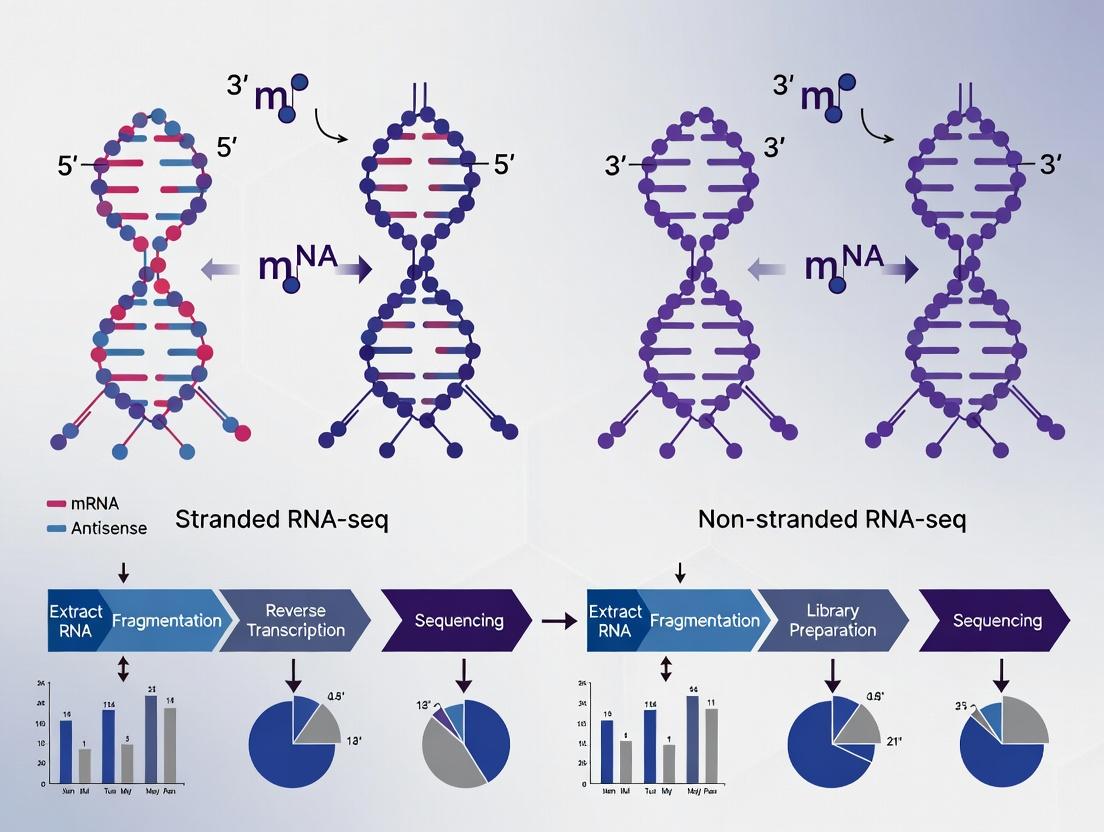
Stranded vs Non-Stranded RNA-Seq: A Definitive Guide for Accurate Transcriptome Analysis in Biomedical Research
This article provides a comprehensive, current guide for researchers and drug development professionals on the critical choice between stranded and non-stranded RNA sequencing.
How_Are_We_Stranded_Here: The Essential Guide to Fast, Accurate RNA-Seq Strandedness QC for Reliable Analysis
Accurate determination of library strandedness is a critical yet often overlooked step in RNA-Sequencing quality control, with incorrect parameters leading to significant false positives/negatives in differential expression analysis[citation:1].

A Practical Guide to Validating Strand Specificity in RNA-Seq Data for Accurate Transcriptomics
Strand-specific RNA-seq is a critical methodological choice that fundamentally impacts data interpretation and biological discovery.
RNA Integrity Number (RIN) in Stranded RNA-Seq: Definitive Guidelines for Library Prep Success
This article provides a comprehensive guide to RNA Integrity Number (RIN) requirements for successful stranded RNA-Seq library preparation.
Diagnosing and Resolving Low Strand Specificity in RNA-Seq: A Step-by-Step Troubleshooting Guide
This article provides researchers, scientists, and drug development professionals with a comprehensive framework for addressing low strand specificity in RNA-seq data.
Unraveling and Mitigating 3' Bias in Stranded RNA-Seq: A Comprehensive Guide for Accurate Transcriptome Analysis
3' bias, the preferential sequencing of transcript termini, is a pervasive and confounding artifact in stranded RNA-seq that distorts gene expression quantification and isoform analysis.

Maximizing Data Fidelity: A Practical Guide to Optimizing Library Complexity in Stranded RNA-Seq
Strand-specific RNA sequencing is pivotal for accurate transcriptome analysis, enabling the unambiguous quantification of overlapping genes and the discovery of regulatory non-coding RNAs.
Combating False Positives in RNA-Seq Analysis: A Modern Guide to Robust Differential Expression for Researchers
This article provides a comprehensive guide for researchers and drug development professionals on tackling the pervasive challenge of false positives in differential expression (DE) analysis.
Resolving Ambiguous Read Mapping in RNA-Seq: Strategies for Accurate Gene Expression, Reproducibility, and Biomedical Insight
Ambiguous read mapping, where sequencing reads align equally well to multiple genomic loci, poses a significant challenge to the accuracy and reproducibility of RNA-seq analysis.
Unlocking Transcriptomic Insights from Challenging Samples: A Comprehensive Guide to Stranded RNA-Seq for Degraded RNA
This article provides researchers and drug development professionals with a complete framework for successfully applying stranded RNA sequencing to degraded RNA samples.