Bulk vs Single-Cell RNA Sequencing: A Comprehensive Guide for Researchers
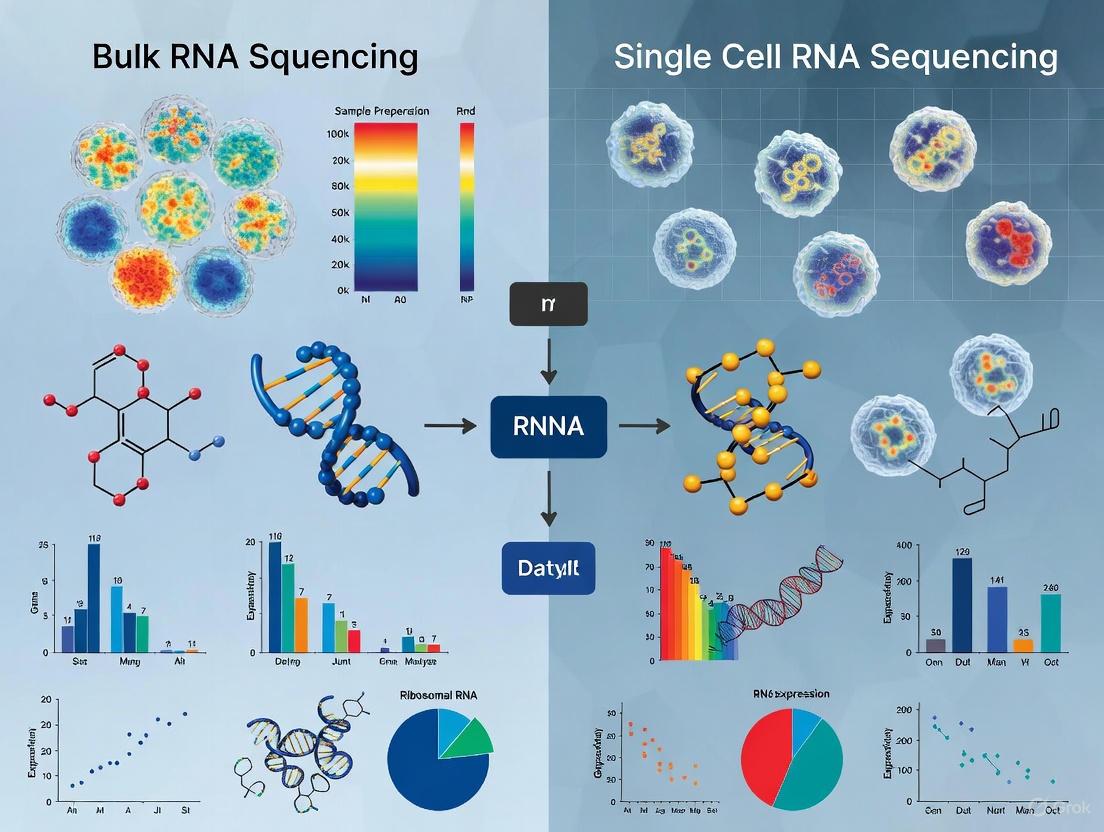
This article provides a definitive comparison of bulk and single-cell RNA sequencing for researchers and drug development professionals.
Bulk vs Single-Cell RNA Sequencing: A Comprehensive Guide for Researchers
Abstract
This article provides a definitive comparison of bulk and single-cell RNA sequencing for researchers and drug development professionals. It covers the foundational principles, key technical differences, and cost considerations of each method. A detailed examination of their respective applications—from differential expression analysis to dissecting tumor heterogeneity—guides appropriate experimental design. The content also addresses common challenges, including data analysis complexity and sample preparation, and explores how integrating both approaches can validate findings and power new discoveries in precision medicine.
Understanding the Core Principles: From Population Averages to Single-Cell Resolution
Bulk RNA sequencing (bulk RNA-seq) is a next-generation sequencing (NGS)-based method that measures the whole transcriptome across a population of thousands to millions of cells [1]. This approach provides a population-level perspective on gene expression, generating an average expression profile for all cells within a sample [1]. Unlike single-cell methods that resolve individual cellular contributions, bulk RNA-seq merges signals from all cell types present, making it analogous to viewing an entire forest rather than examining individual trees [1]. This technique has become a fundamental tool in transcriptomics, enabling researchers to quantify gene expression patterns, identify differentially expressed genes, and discover biomarkers across various biological conditions.
Key Technological Principles
The core principle of bulk RNA-seq involves analyzing RNA extracted from entire tissue samples or cell populations, which inherently combines transcripts from all cell types present [2]. During analysis, the resulting data represents the average gene expression across this heterogeneous mixture [1]. This contrasts with single-cell RNA sequencing (scRNA-seq), which partitions individual cells before sequencing to resolve cell-to-cell variation [3]. The population averaging in bulk RNA-seq makes it particularly powerful for detecting overall expression trends but limits its ability to resolve cellular heterogeneity within samples [1].
Direct Comparison: Bulk vs. Single-Cell RNA Sequencing
Table 1: Technical and practical comparison between bulk and single-cell RNA sequencing approaches
| Feature | Bulk RNA Sequencing | Single-Cell RNA Sequencing |
|---|---|---|
| Resolution | Population-level average [1] | Individual cell level [3] |
| Cost per Sample | Lower (~$300/sample) [3] | Higher (~$500-$2000/sample) [3] |
| Data Complexity | Lower, less computationally intensive [3] | Higher, requires specialized computational methods [3] |
| Cell Heterogeneity Detection | Limited, masks cellular subtypes [1] | High, identifies rare cell populations [3] |
| Sample Input Requirement | Higher (micrograms of RNA) [3] | Lower (single cells or picograms of RNA) [3] |
| Gene Detection Sensitivity | Higher genes detected per sample [3] | Lower genes detected per cell [3] |
| Splicing Analysis | More comprehensive for isoform detection [1] | Limited due to sparse data per cell [3] |
| Experimental Workflow | Simpler sample preparation [1] | Complex single-cell isolation required [1] |
Table 2: Performance characteristics and optimal use cases for each method
| Characteristic | Bulk RNA Sequencing | Single-Cell RNA Sequencing |
|---|---|---|
| Ideal Applications | Differential expression between conditions, biomarker discovery, large cohort studies [1] | Cellular heterogeneity mapping, rare cell identification, developmental trajectories [1] |
| Technical Challenges | Cannot resolve cellular origins of expression signals [1] | Dropout events, sparsity, higher technical noise [3] |
| Data Output | Gene counts representing population averages [4] | Gene counts per cell with cell barcodes [1] |
| Replicate Concordance | Spearman correlation >0.9 between isogenic replicates [5] | Higher variability between technical replicates |
| Recommended Sequencing Depth | 20-30 million aligned reads per sample [5] | 5-50 thousand reads per cell [5] |
Experimental Design and Methodologies
Bulk RNA-Seq Workflow and Protocols
The standard bulk RNA-seq experimental workflow follows a structured pathway from sample collection to data interpretation, with critical quality control checkpoints at each stage.
Standardized Processing Pipelines
Reproducible processing of bulk RNA-seq data typically follows established pipelines such as the ENCODE Bulk RNA-seq pipeline, which provides standardized methods for alignment and quantification [5]. This pipeline can process both paired-end and single-end sequencing data, with specific quality thresholds including minimum read lengths of 50 base pairs and requirements for replicate concordance (Spearman correlation >0.9 between isogenic replicates) [5].
The nf-core RNA-seq workflow represents another robust pipeline option that implements best practices for comprehensive analysis [6]. This workflow typically employs a hybrid approach using STAR for splice-aware alignment to the genome followed by Salmon for alignment-based quantification, balancing the need for quality control metrics with accurate expression estimation [6]. This combination leverages the strengths of both tools: STAR provides detailed alignment information for quality checks, while Salmon uses statistical models to handle uncertainty in read assignment and count estimation [6].
Essential Research Reagents and Tools
Table 3: Key reagents, tools, and their functions in bulk RNA-seq experiments
| Category | Item | Function/Purpose |
|---|---|---|
| Sample Preparation | Poly(A) selection beads or rRNA depletion kits | mRNA enrichment from total RNA [7] |
| ERCC Spike-in controls | External RNA controls for normalization [5] | |
| Library Preparation | Fragmentation enzymes | RNA or cDNA fragmentation to optimal size [7] |
| Reverse transcriptase | cDNA synthesis from RNA templates [1] | |
| Adapter ligation enzymes | Addition of sequencing adapters [7] | |
| Computational Tools | STAR aligner | Spliced alignment of reads to reference genome [2] |
| Salmon | Pseudoalignment and transcript quantification [6] | |
| DESeq2/edgeR | Differential expression analysis [4] [7] | |
| FastQC | Quality control of raw sequencing data [2] |
Data Analysis and Visualization Framework
Differential Expression Analysis
The statistical foundation of bulk RNA-seq analysis relies on identifying differentially expressed genes (DEGs) between experimental conditions. The DESeq2 package implements a negative binomial generalized linear model to test for differential expression, while accounting for overdispersion in count data and library size differences [4]. The workflow involves several key steps:
- Count Matrix Preprocessing: Raw count data is filtered to remove genes with low expression across samples [4]
- Normalization: DESeq2 estimates size factors to account for differences in sequencing depth between samples [4]
- Dispersion Estimation: Gene-wise dispersion estimates are calculated to model variance-mean dependence [4]
- Statistical Testing: The Wald test is typically applied to compare expression between groups [4]
- Multiple Testing Correction: Benjamini-Hochberg procedure controls false discovery rate (FDR) across thousands of tests [4]
For effect size estimation, the apeglm package provides empirical Bayes shrinkage estimators for log2 fold-change values, preventing inflation of fold-changes for lowly expressed genes and providing more biologically meaningful estimates [4].
Quality Assessment and Visualization
Comprehensive quality assessment is critical for ensuring reliable bulk RNA-seq results. The following visualization approaches help researchers evaluate data quality and interpret results:
Principal Component Analysis (PCA) is particularly valuable for visualizing global expression patterns and assessing sample relationships [4]. In PCA plots, samples grouping closely together indicate high reproducibility, while separation along principal components often corresponds to experimental conditions or batch effects [7]. Additional visualization methods include:
- Volcano plots: Display statistical significance versus magnitude of expression change [4]
- Heatmaps: Visualize expression patterns of DEGs across samples [4]
- Parallel coordinate plots: Show expression patterns of individual genes across samples, helping identify consistent patterns between replicates and divergent patterns between treatments [8]
Applications and Integration with Single-Cell Approaches
Complementary Applications in Research
Bulk and single-cell RNA sequencing serve complementary roles in modern transcriptomics research. Bulk RNA-seq excels in multiple applications:
- Differential gene expression analysis: Identifying genes upregulated or downregulated between conditions (e.g., disease vs. healthy, treated vs. control) [1]
- Biomarker discovery: Finding molecular signatures for diagnosis, prognosis, or patient stratification [1]
- Pathway analysis: Investigating how sets of genes change collectively under various biological conditions [1]
- Large cohort studies: Profiling transcriptomes in biobank-scale projects where cost considerations are paramount [1]
Integrated Study Designs
Forward-thinking research increasingly combines both approaches to leverage their complementary strengths [3]. Huang et al. (2024) demonstrated this powerful integration in their study of B-cell acute lymphoblastic leukemia (B-ALL), where they used both bulk and single-cell RNA-seq to identify developmental states driving resistance and sensitivity to the chemotherapeutic agent asparaginase [1]. In such integrated designs:
- Bulk RNA-seq provides the broad context of overall expression changes across samples
- Single-cell RNA-seq deconvolutes heterogeneous samples to identify specific cell populations driving bulk-level signals [1]
- Cross-validation between platforms increases confidence in findings
- Bulk data can support deconvolution studies using single-cell RNA-seq reference maps [1]
This synergistic approach enables researchers to both observe forest-level patterns and examine individual trees, providing a comprehensive understanding of complex biological systems.
The advent of single-cell RNA sequencing (scRNA-seq) represents a transformative milestone in molecular biology, enabling researchers to investigate gene expression profiles at unprecedented resolution. While traditional bulk RNA sequencing (bulk RNA-seq) provides a population-averaged view of gene expression across entire tissue samples, scRNA-seq unveils the cellular heterogeneity hidden within these populations [1] [9]. This technological evolution has fundamentally altered our understanding of biological systems, revealing complex cellular ecosystems that drive development, homeostasis, and disease pathogenesis.
The fundamental distinction between these approaches lies in their resolution. Bulk RNA-seq analyzes RNA from thousands to millions of cells simultaneously, yielding a composite expression profile that averages signals across all cell types present in the sample [1] [9]. In contrast, scRNA-seq partitions individual cells into separate reaction vessels, allowing for the precise measurement of gene expression in each cell independently [1]. This capability has proven particularly valuable for studying complex tissues like the brain, immune system, and tumors, where diverse cell types interact to create functional networks and disease states [10] [11].
Technical Foundations: Methodological Comparisons
Core Workflow Differences
The experimental workflows for bulk and single-cell RNA-seq diverge significantly at the initial sample preparation stage. In bulk RNA-seq, the entire tissue or cell population is processed collectively for RNA extraction, library preparation, and sequencing [1]. This consolidated approach provides an averaged gene expression readout but obscures cell-to-cell variation.
In contrast, scRNA-seq requires the generation of viable single-cell suspensions through enzymatic or mechanical dissociation of tissues, followed by careful quality control to ensure cell viability and integrity [1] [10]. The partitioned cells are then individually barcoded during the reverse transcription step, enabling thousands of cells to be pooled for sequencing while maintaining the ability to trace transcripts back to their cell of origin [1]. For the 10x Genomics platform, this partitioning occurs within microfluidic chips on specialized instruments that isolate single cells into gel bead-in-emulsions (GEMs) where cell lysis and barcoding occur [1].
Comparative Workflow Visualization
The following diagram illustrates the key procedural differences between bulk and single-cell RNA sequencing workflows:
Comprehensive Method Comparison
Table 1: Technical and practical comparison between bulk and single-cell RNA-seq
| Parameter | Bulk RNA-Seq | Single-Cell RNA-Seq |
|---|---|---|
| Resolution | Population-averaged expression [1] | Individual cell resolution [1] |
| Cell Heterogeneity | Masks cellular diversity [9] | Reveals cellular heterogeneity and rare cell types [1] [11] |
| Cost per Sample | Lower cost [1] [12] | Higher cost, though decreasing [1] |
| Sample Input | Entire tissue/cell population | Viable single-cell suspension [1] [10] |
| Technical Complexity | Straightforward workflow with established protocols [12] | Complex sample prep requiring specialized equipment [1] |
| Data Output | Single expression profile per sample | Thousands of expression profiles (one per cell) [1] |
| Ideal Applications | Differential expression between conditions, biomarker discovery [1] | Cell type identification, developmental trajectories, tumor heterogeneity [1] [11] |
| Limitations | Cannot resolve cell-type-specific signals in heterogeneous samples [1] | Sensitive to sample quality, higher computational demands [1] [10] |
Experimental Design and Performance Benchmarking
Method Selection for Specific Research Questions
Choosing between bulk and single-cell RNA-seq depends primarily on the research question and available resources. Bulk RNA-seq remains the preferred method for studies requiring cost-effective analysis of many samples, such as large cohort studies or time-series experiments where the primary goal is to identify overall expression differences between conditions [1] [12]. Its established protocols and analytical pipelines make it particularly suitable for projects with limited bioinformatics support.
scRNA-seq is indispensable when investigating cellular heterogeneity, identifying novel cell types or states, or reconstructing developmental trajectories [1] [11]. Recent technological advances have progressively reduced barriers to adoption through optimized assays like the 10x Genomics GEM-X Flex, which lowers per-cell costs and enables higher-throughput studies [1]. For clinical samples with limitations in immediate processing, single-nuclei RNA sequencing (snRNA-seq) provides a valuable alternative that allows sample preservation without compromising data quality [10].
Experimental Data from Comparative Studies
Recent investigations have directly compared the performance and outputs of these complementary technologies. A 2024 study by Huang et al. exemplified their synergistic application in B-cell acute lymphoblastic leukemia (B-ALL), where bulk RNA-seq identified differential expression patterns in response to asparaginase treatment, while scRNA-seq pinpointed the specific developmental states driving chemoresistance [1].
A 2025 methodological comparison focused on neutrophil transcriptomics evaluated three scRNA-seq platforms—10x Genomics Flex, PARSE Biosciences Evercode, and HIVE—for clinical biomarker studies [13]. All methods successfully captured neutrophil transcriptomes despite technical challenges posed by their low mRNA content and high RNase levels. The 10x Genomics Flex platform demonstrated particular utility for clinical settings due to its simplified sample collection protocol and strong concordance with flow cytometry data [13].
Table 2: Performance metrics of scRNA-seq methods in clinical neutrophil profiling
| Method | Cell Capture Efficiency | Protocol Complexity | Data Quality | Clinical Suitability |
|---|---|---|---|---|
| 10x Genomics Flex | High | Simplified workflow | Strong concordance with flow cytometry | High - optimized for clinical collection [13] |
| PARSE Evercode | High | Moderate | High-quality transcriptomes | Moderate [13] |
| HIVE | Moderate | Complex | Captured neutrophil transcripts | Lower due to complexity [13] |
Integrated Analysis Approaches
Computational methods have emerged to leverage the strengths of both approaches through deconvolution algorithms that infer cell-type-specific information from bulk RNA-seq data using scRNA-seq references. EPIC-unmix, a novel empirical Bayesian method published in 2025, demonstrates superior performance in accurately estimating cell-type-specific expression profiles from bulk data [14]. This integration strategy proves particularly valuable for large cohort studies where scRNA-seq profiling of all samples remains cost-prohibitive.
In hepatocellular carcinoma research, scientists successfully combined scRNA-seq and bulk RNA-seq to identify liquid-liquid phase separation-related prognostic biomarkers [15]. The scRNA-seq data first identified malignant hepatocytes with high LLPS scores, revealing their strong interactions with other cells through EGFR-ERGF and MIF-CD44 signaling pathways. These findings were then validated through bulk RNA-seq analysis of larger cohorts, enabling development of a robust prognostic model [15].
Essential Research Reagents and Platforms
The successful implementation of scRNA-seq experiments requires specialized reagents and platforms designed to maintain cell viability, ensure efficient barcoding, and minimize technical variation.
Table 3: Essential research reagents and platforms for single-cell RNA sequencing
| Reagent/Platform | Function | Application Notes |
|---|---|---|
| Chromium X Series (10x Genomics) | Microfluidic instrument for single-cell partitioning | Automates cell encapsulation into GEMs; critical for reproducible barcoding [1] |
| Gel Beads | Delivery of barcoded oligonucleotides | Contain cell-specific barcodes released upon dissolution in GEMs [1] |
| Viability Stains (e.g., DAPI, propidium iodide) | Assessment of cell viability prior to sequencing | Crucial for quality control as low viability drastically impacts data quality [1] |
| Enzymatic Dissociation Kits | Tissue dissociation into single-cell suspensions | Must be optimized for specific tissues to minimize stress responses [10] |
| Single Cell 3' Reagent Kits | Library preparation for 3' transcript counting | Cost-effective for cell typing and differential expression [1] |
| Single Cell 5' Reagent Kits | Library preparation for 5' transcript counting | Preserves V(D)J information for immune profiling [1] |
| cDNA Amplification Kits | Amplification of barcoded cDNA | Critical step due to minimal starting RNA in single cells [10] |
| Demonstrated Protocols (10x Genomics) | Optimized tissue-specific protocols | Provide validated methods for >40 tissue types [1] |
Analytical Frameworks and Computational Approaches
Bioinformatics Workflow for scRNA-seq Data
The analysis of scRNA-seq data presents distinct computational challenges compared to bulk RNA-seq, requiring specialized tools for quality control, normalization, and interpretation. The following diagram outlines a standard analytical workflow for single-cell data:
Machine Learning in scRNA-seq Analysis
Machine learning algorithms have become indispensable for extracting biological insights from high-dimensional scRNA-seq data. A 2025 bibliometric analysis identified random forests and deep learning models as particularly prominent in scRNA-seq research [16]. These methods enable key analytical tasks including:
- Clustering analysis utilizing hierarchical, graph-based, and model-based approaches to identify distinct cell types and states [16]
- Dimensionality reduction through Principal Component Analysis (PCA), t-Distributed Stochastic Neighbor Embedding (t-SNE), and Uniform Manifold Approximation and Projection (UMAP) for visualization and downstream analysis [10] [16]
- Trajectory inference using algorithms like TIGON to reconstruct developmental pathways and cellular differentiation dynamics [16]
- Cell type annotation through combined deep learning and statistical approaches that significantly improve classification accuracy [16]
The integration of artificial intelligence with scRNA-seq data represents a growing frontier, with demonstrated applications in tumor microenvironment characterization, immunotherapy response prediction, and identification of novel cellular biomarkers [10] [16].
Clinical Applications and Translational Potential
The implementation of scRNA-seq in clinical investigations has yielded transformative insights into disease mechanisms across diverse medical specialties. In oncology, scRNA-seq has enabled the precise characterization of tumor heterogeneity, identification of therapy-resistant clones, and mapping of cancer stem cell populations [10] [11]. Beyond cancer, scRNA-seq applications have illuminated pathological mechanisms in respiratory diseases, metabolic disorders, cardiovascular conditions, autoimmune diseases, and neurodegenerative disorders [10].
A key translational application lies in biomarker discovery and drug development. The technology enables identification of novel therapeutic targets by resolving cell-type-specific responses to existing treatments and revealing previously unappreciated disease drivers [10]. For instance, in the hepatocellular carcinoma study mentioned previously, the integration of scRNA-seq and bulk RNA-seq facilitated the development of a prognostic model based on liquid-liquid phase separation-related genes, with potential implications for patient stratification and targeted therapy [15].
The emergence of spatial transcriptomics technologies further enhances the clinical utility of scRNA-seq by preserving spatial context, which is often critical for understanding tissue microarchitecture and cell-cell communication networks in pathological states [17]. As these technologies continue to mature and decrease in cost, their implementation in clinical trial design and personalized medicine approaches is expected to expand significantly.
Single-cell RNA sequencing has fundamentally expanded our analytical capabilities in transcriptomics, providing a powerful lens through which to examine cellular heterogeneity and dynamic biological processes. While bulk RNA-seq remains a valuable tool for population-level analyses, particularly in large cohort studies, scRNA-seq offers unparalleled resolution for deconstructing complex tissues and identifying rare cell populations. The most insightful approaches frequently integrate both methodologies, leveraging their complementary strengths to advance both basic biological understanding and clinical applications in the era of precision medicine.
For researchers, scientists, and drug development professionals, selecting the appropriate RNA sequencing method is crucial for experimental success and data quality. Bulk RNA sequencing (bulk RNA-seq) and single-cell RNA sequencing (scRNA-seq) represent two fundamentally different approaches to transcriptome analysis, each with distinct technological profiles. Bulk RNA-seq measures the average gene expression across a population of heterogeneous cells, while scRNA-seq analyzes gene expression profiles of individual cells, enabling the resolution of cellular heterogeneity. Understanding their key differences in workflow, resolution, and input requirements is essential for designing robust studies and accurately interpreting results within biomedical research and therapeutic development.
At a Glance: Core Technological Differences
Table 1: High-level comparison of bulk versus single-cell RNA sequencing.
| Feature | Bulk RNA-Seq | Single-Cell RNA-Seq |
|---|---|---|
| Resolution | Population-average gene expression [1] [18] | Gene expression at individual cell level [1] [19] |
| Primary Input | Tissue piece or cell pellet (population of cells) [1] | Viable single-cell suspension [1] |
| Key Workflow Divergence | RNA extracted directly from lysed tissue/cells [1] | Cells partitioned into individual reactions before RNA capture [1] [20] |
| Typical Cost | Lower cost per sample [1] [21] | Higher cost per sample [1] [21] |
| Data Complexity | Lower; simpler analysis [1] | Higher; requires specialized computational tools [1] [22] |
| Ideal Application | Differential gene expression between conditions; biomarker discovery [1] [20] | Cellular heterogeneity; rare cell population discovery; developmental trajectories [1] [18] |
Workflow and Input Requirements: A Detailed Comparison
The experimental workflows for bulk and single-cell RNA-seq diverge significantly from the very first step, primarily due to their fundamental difference in resolution.
Bulk RNA-Seq Workflow
The bulk RNA-seq workflow is relatively straightforward. It begins with a piece of tissue or a pellet of cells, from which total RNA is directly extracted upon lysis. This RNA, representing the averaged transcriptome of thousands to millions of cells, is then converted to cDNA and processed into a sequencing library [1]. This workflow does not require special steps to maintain cell integrity during initial processing, as the immediate goal is nucleic acid extraction.
Single-Cell RNA-Seq Workflow
In contrast, the scRNA-seq workflow is more complex and technically demanding. The critical first step is the preparation of a viable single-cell suspension from the starting tissue through enzymatic or mechanical dissociation. This requires careful optimization to ensure high cell viability and to prevent the formation of cell clumps or debris, which can clog microfluidic chips [1] [22]. A crucial and distinct stage that follows is instrument-enabled cell partitioning.
Platforms like the 10x Genomics Chromium system isolate individual cells into tiny oil-encapsulated droplets called GEMs (Gel Beads-in-emulsion). Within each GEM, a unique cell-specific barcode labels all RNA molecules from that single cell, allowing bioinformatic tracing back to each cell of origin after sequencing [1] [20]. This barcoding step is what enables the high-resolution, multi-cell data output.
Experimental Resolution and Data Output
The difference in workflow directly dictates the fundamental difference in resolution and data output between the two methods.
Bulk RNA-Seq: The Population Average - Bulk RNA-seq provides a readout of the gene expression profile for the entire sample, with many different cells pooled together. The resulting data represents the average expression levels for individual genes across all cells in the sample. This can mask the cellular origins of gene expression signals, particularly in heterogeneous tissues, and obscure rare but biologically critical cell populations [1] [20].
Single-Cell RNA-Seq: The Cellular Census - scRNA-seq provides a whole transcriptome gene expression profile for each individual cell in a sample. This allows researchers to identify and characterize distinct cell types and cell states, quantify their proportions, and reveal gene expression differences between similar cell subpopulations. It is uniquely powerful for uncovering rare cell types or transient states that play key roles in development, disease, or treatment resistance [1] [20] [19].
Table 2: Key differences in data output and analytical capabilities.
| Analytical Aspect | Bulk RNA-Seq | Single-Cell RNA-Seq |
|---|---|---|
| Heterogeneity Analysis | Masks cellular heterogeneity [1] | Reveals cellular heterogeneity and rare cell types [1] [20] |
| Primary Output | Average gene expression for the sample [1] | Gene expression matrix per cell [1] |
| Key Strengths | Differential expression between conditions; biomarker discovery; splicing analysis [1] [18] | Cell type identification; developmental trajectory inference; cell-state transitions [1] [18] |
| Data Sparsity | Dense data matrix | Sparse data matrix with "dropout" events [22] |
Case Studies in Integrated Experimental Design
Modern research often leverages both technologies in a complementary manner. The following case studies illustrate how their distinct resolutions and workflows are applied in practice.
Case Study 1: Investigating Tumor Microenvironment in Retinoblastoma
Objective: To explore tumor microenvironment (TME) heterogeneity and identify key genes associated with invasion in Retinoblastoma (RB) [23].
Experimental Protocols and Data Integration:
- scRNA-seq Analysis: Publicly available scRNA-seq data from 10 RB patient tumor tissues was analyzed. The analysis involved:
- Clustering and Annotation: Using the Seurat R package to cluster cells and identify distinct subpopulations.
- Sub-clustering: Focusing on cone precursor (CP) cells to reveal finer malignant subpopulations.
- CNV Inference: Using the InferCNV package to distinguish malignant from normal cells based on copy number variations.
- Cell-Cell Communication: Applying CellPhoneDB to analyze rewired ligand-receptor interactions between invasive and non-invasive tumors [23].
- Bulk RNA-seq Analysis: Independent bulk RNA-seq data was used to:
- Identify Molecular Subtypes: Unsupervised consensus clustering revealed two molecular subtypes with distinct TME characteristics.
- Validate Key Gene: Analysis identified DOK7 as a key gene associated with invasion [23].
- Functional Validation: In vitro experiments with Y79 cell lines, including DOK7 knockdown via siRNA and functional assays (qPCR, CCK-8, Transwell), confirmed its role in promoting tumor progression [23].
Conclusion: The single-cell data resolved the cellular heterogeneity of the TME and pinpointed specific malignant subpopulations and communication networks, while the bulk data provided a broader view for subtype classification and biomarker identification, subsequently validated functionally.
Case Study 2: Uncovering Macrophage Heterogeneity in Rheumatoid Arthritis
Objective: To elucidate the heterogeneity of macrophages and their role in the progression of Rheumatoid Arthritis (RA) [24].
Experimental Protocols and Data Integration:
- Integrated Sequencing Analysis: Researchers integrated public scRNA-seq and bulk RNA-seq datasets from RA and control synovial tissues.
- scRNA-seq Workflow:
- Data Integration and Clustering: The Seurat workflow and Harmony algorithm were used to batch-correct and cluster 26,923 cells.
- Myeloid Sub-clustering: Myeloid cells were extracted and re-clustered, revealing a Stat1+ macrophage subset elevated in RA.
- Pathway Enrichment: Stat1+ macrophages were found to be enriched in inflammatory pathways [24].
- Bulk Data Correlation and Validation: Bulk RNA-seq analysis and an Adjuvant-Induced Arthritis (AIA) rat model confirmed the upregulated expression of STAT1 in RA.
- Functional Investigation: In vitro experiments showed that STAT1 activation upregulated LC3 and ACSL4 while downregulating p62 and GPX4, suggesting STAT1 modulates autophagy and ferroptosis pathways—effects reversed by fludarabine treatment [24].
Conclusion: The study used scRNA-seq to discover a novel, pathogenic macrophage subset within the complex RA synovium, which was then contextualized and validated using bulk data and animal models, revealing a potential new therapeutic target.
The Scientist's Toolkit: Essential Research Reagents and Materials
Successful execution of RNA sequencing experiments, particularly scRNA-seq, relies on specific reagents and platforms.
Table 3: Key research reagents and solutions for RNA sequencing workflows.
| Item | Function | Application Context |
|---|---|---|
| Viable Single-Cell Suspension | Starting material where individual, live cells are dissociated from tissue. | Critical for scRNA-seq; requires optimization of dissociation protocol [1] [22]. |
| Partitioning Instrument & Chips | Microfluidic devices (e.g., 10X Chromium Controller) to isolate single cells into droplets. | Essential for high-throughput scRNA-seq platforms [1] [20]. |
| Barcoded Gel Beads | Beads containing cell barcodes and UMIs to label all RNA from a single cell. | Used in droplet-based scRNA-seq (e.g., 10X Genomics) for multiplexing [20]. |
| Cell Lysis Buffer | Reagent to break open cells and release RNA while preserving RNA integrity. | Used in both bulk and scRNA-seq; in scRNA-seq, lysis occurs after partitioning [1]. |
| mRNA Capture Oligos (dT) | Oligonucleotides with poly(dT) stretches to selectively bind polyadenylated mRNA. | Used in both protocols to enrich for mRNA and deplete rRNA [22]. |
| Library Preparation Kit | Reagents for cDNA synthesis, amplification, and addition of sequencing adapters. | Required for both bulk and scRNA-seq to make NGS-compatible libraries [1]. |
Bulk and single-cell RNA sequencing are not mutually exclusive technologies but rather complementary tools in the modern researcher's arsenal. Bulk RNA-seq remains a powerful, cost-effective method for analyzing gene expression across large sample sizes and identifying broad transcriptional changes. In contrast, single-cell RNA-seq provides an unparalleled view into cellular heterogeneity, enabling the discovery of novel cell types, states, and dynamic processes. The choice between them—or the decision to integrate both—is fundamentally guided by the research question, driven by the critical trade-offs between resolution, cost, workflow complexity, and analytical depth.
In transcriptomics research, choosing between bulk RNA sequencing (bulk RNA-seq) and single-cell RNA sequencing (scRNA-seq) represents a critical decision point that directly impacts experimental outcomes, data complexity, and resource allocation. Bulk RNA-seq analyzes RNA from a population of cells, providing an averaged gene expression profile for the entire sample. In contrast, scRNA-seq isolates individual cells before sequencing, enabling the investigation of gene expression variations within heterogeneous populations [3]. This guide provides a detailed comparison of these technologies' cost structures, throughput capabilities, and experimental requirements to help researchers and drug development professionals make informed decisions aligned with their scientific goals and budgetary constraints.
Direct Cost and Throughput Comparison
The financial and practical implications of choosing between bulk and single-cell RNA sequencing are substantial, with each method offering distinct advantages for different experimental scales.
Table 1: Direct Cost and Throughput Comparison
| Feature | Bulk RNA Sequencing | Single-Cell RNA Sequencing |
|---|---|---|
| Cost per Sample | ~$300 [3] | $500-$2,000 [3] |
| Relative Cost | Lower (~1/10th of scRNA-seq) [3] | Higher (Up to 10x bulk cost) [3] [1] |
| Cell Throughput | Population-level (thousands to millions of cells) [9] | Individual cell level (hundreds to tens of thousands of cells) [3] [25] |
| Sequencing Depth | Varies by experiment [25] | 30,000-150,000 reads/cell [25] |
| Reagent Cost Factor | Baseline | 10-20x higher than bulk [25] |
| Sequencing Cost Factor | Baseline | 10-20x higher than bulk [25] |
| Ideal Use Case | Large cohort studies, homogeneous samples [3] [1] | Heterogeneous tissues, rare cell detection [3] [1] |
The cost differential stems from several technical factors. Single-cell RNA sequencing requires specialized reagents for cell partitioning and barcoding, with reagent costs typically running 10-20 times higher than bulk RNA sequencing experiments [25]. Furthermore, scRNA-seq requires substantially greater sequencing depth to achieve statistically significant data from individual cells, further increasing overall expenses [25]. However, despite higher per-sample costs, scRNA-seq provides unparalleled resolution for detecting cellular heterogeneity that bulk methods cannot achieve [1].
Experimental Design and Methodologies
The experimental workflows for bulk and single-cell RNA sequencing diverge significantly from the initial sample preparation stage, each presenting distinct technical considerations and challenges.
Bulk RNA Sequencing Workflow
Bulk RNA sequencing begins with RNA extraction directly from a tissue sample or cell culture, capturing the transcriptome from the entire cell population simultaneously [3] [1].
Key Steps in Bulk RNA-seq Protocol:
- Total RNA Extraction: RNA is isolated from the entire tissue or cell population sample [1].
- Library Preparation: Extracted RNA is converted to complementary DNA (cDNA), followed by adapter ligation and amplification to create a sequencing-ready library [1].
- Sequencing: Libraries are sequenced using next-generation sequencing platforms [3].
- Data Analysis: Population-averaged gene expression profiles are generated and analyzed for differential expression [3] [2].
Bulk sequencing provides a composite gene expression profile representing the average of all cells in the sample. This approach works exceptionally well for homogeneous cell populations or when studying overall tissue responses [3].
Single-Cell RNA Sequencing Workflow
Single-cell RNA sequencing introduces additional complexity to isolate and barcode individual cells before sequencing, enabling cell-specific transcriptome analysis [3] [20].
Key Steps in scRNA-seq Protocol:
- Single-Cell Suspension: Tissues are dissociated into viable single-cell suspensions through enzymatic or mechanical digestion [1].
- Cell Partitioning: Individual cells are isolated into micro-reaction vessels (e.g., GEMs - Gel Beads-in-emulsion) using microfluidic systems [1] [20].
- Cell Barcoding: Each cell's RNA is labeled with cell-specific barcodes during reverse transcription, allowing bioinformatic tracing back to individual cells after sequencing [1] [20] [25].
- Library Preparation & Sequencing: Barcoded products are pooled for library preparation and sequenced [1].
- Data Analysis: Specialized computational methods process the data to account for increased noise and sparsity, enabling cell-type identification and heterogeneity analysis [3] [2].
Application-Based Selection Guide
The choice between bulk and single-cell RNA sequencing should be primarily driven by the research question, sample characteristics, and analytical requirements.
Table 2: Application-Based Technology Selection
| Research Goal | Recommended Technology | Rationale |
|---|---|---|
| Differential Gene Expression | Bulk RNA-seq [1] | Cost-effective for comparing expression between conditions (e.g., disease vs. healthy) |
| Biomarker Discovery | Bulk RNA-seq [3] [1] | Efficient for identifying population-level expression signatures |
| Gene Fusion Detection | Bulk RNA-seq [20] | More comprehensive for identifying novel transcripts and splicing variants |
| Cellular Heterogeneity | Single-Cell RNA-seq [3] [1] | Uniquely identifies distinct cell types and states within complex tissues |
| Rare Cell Population Detection | Single-Cell RNA-seq [3] | Detects cell types occurring at frequencies as low as 1 in 10,000 cells |
| Developmental Trajectories | Single-Cell RNA-seq [1] | Reconstructs cellular differentiation pathways and lineage relationships |
| Tumor Microenvironment | Single-Cell RNA-seq [23] [26] | Dissects complex interactions between cancer, immune, and stromal cells |
| Immune Cell Profiling | Single-Cell RNA-seq [3] [1] | Discovers new immune cell subsets and their functional states |
The decision framework extends beyond applications to sample characteristics. Bulk RNA sequencing is particularly suitable for homogeneous samples or when studying collective biological responses [3]. Its cost structure makes it ideal for large-scale studies requiring numerous samples, such as clinical cohort analyses or biobank projects [1]. In contrast, single-cell RNA sequencing is indispensable for heterogeneous tissues like tumors, where understanding cellular diversity is crucial [3] [26]. The technology has been instrumental in identifying previously unknown cell types and transient states that were indistinguishable in bulk sequencing data [3].
Research Reagent Solutions and Essential Materials
Successful RNA sequencing experiments require careful selection of reagents and materials tailored to each technology's specific requirements.
Table 3: Essential Research Reagents and Materials
| Item | Function | Technology |
|---|---|---|
| Cell Suspension Solutions | Dissociate tissues into viable single cells while preserving RNA integrity [1] | scRNA-seq |
| Cell Barcoding Beads | Gel beads with cell-specific barcodes for labeling individual cell transcriptomes [1] [20] | scRNA-seq |
| Microfluidic Chips | Partition individual cells into nanoliter-scale reactions for processing [1] [20] | scRNA-seq |
| mRNA Capture Oligos | Oligo-dT conjugated primers for mRNA enrichment during reverse transcription [20] | Both |
| UMI Reagents | Unique Molecular Identifiers to label and quantify unique mRNA transcripts [20] | Both |
| Library Prep Kits | Prepare sequencing libraries with appropriate adapters for platform compatibility [1] | Both |
| RNA Extraction Kits | Isolate high-quality total RNA from tissues or cell populations [1] | Bulk RNA-seq |
| rRNA Depletion Kits | Remove ribosomal RNA to enrich for coding and non-coding transcripts of interest [20] | Both |
The single-cell RNA sequencing workflow places particular emphasis on cell viability and sample quality. The initial generation of a high-quality single-cell suspension is critical, as clumps or excessive debris can compromise microfluidic partitioning and barcoding efficiency [1]. For bulk RNA sequencing, the focus shifts to RNA quality and quantity, with sufficient input material being essential for robust library preparation [3]. Recent technological advancements have led to the development of targeted scRNA-seq approaches that focus sequencing resources on predefined gene sets, providing superior sensitivity for specific pathways while reducing costs compared to whole transcriptome methods [27].
Data Analysis and Computational Considerations
The computational requirements and analytical approaches differ substantially between bulk and single-cell RNA sequencing data, impacting both infrastructure needs and expertise requirements.
Bulk RNA sequencing data analysis follows a relatively standardized pipeline including quality control, read alignment, expression quantification, and differential expression analysis [2]. The data complexity is lower because it represents an average gene expression across the entire cell population [3]. Tools like FastQC for quality control, STAR for read alignment, and featureCounts for expression quantification are commonly employed [2]. Differential expression analysis can be performed with established statistical methods, making bulk RNA-seq more accessible to labs with limited bioinformatics support [2].
Single-cell RNA sequencing generates substantially more complex data structures requiring specialized computational methods [3] [2]. The analysis pipeline must account for technical artifacts like batch effects, data sparsity from dropout events where expressed genes fail to be detected, and the high dimensionality of measuring thousands of genes across thousands of individual cells [3] [2]. Analysis typically involves specialized tools for cell clustering (e.g., Seurat), trajectory inference (e.g., Monocle), and cell-cell communication prediction (e.g., CellPhoneDB) [23] [26]. These analyses require substantial computational resources and bioinformatics expertise, representing a significant consideration when choosing scRNA-seq [3].
Bulk and single-cell RNA sequencing technologies offer complementary strengths for transcriptomic research. Bulk RNA-seq provides a cost-effective solution for population-level studies, differential expression analysis, and large cohort projects where cellular heterogeneity is not the primary focus. Single-cell RNA-seq, despite its higher per-sample cost, delivers unparalleled resolution for dissecting cellular heterogeneity, identifying rare cell populations, and mapping developmental trajectories. The optimal choice depends on aligning technological capabilities with specific research questions, sample characteristics, and available resources. As both technologies continue to evolve, we are seeing promising trends toward cost reduction in scRNA-seq and the development of integrated approaches that combine both methods to provide comprehensive biological insights [3] [1].
Choosing Your Tool: Methodological Insights and Application-Specific Use Cases
In the evolving landscape of transcriptomics, researchers must strategically select the appropriate sequencing method to address their specific biological questions. While single-cell RNA sequencing (scRNA-seq) has emerged as a powerful tool for resolving cellular heterogeneity, bulk RNA sequencing remains an indispensable workhorse for numerous applications in biomedical research. This method, which analyzes the average gene expression from a population of cells, provides a robust, cost-effective, and statistically powerful approach for answering fundamental questions about transcriptional states across biological conditions [1] [18]. This guide objectively examines the ideal applications for bulk RNA-seq, focusing on its core strengths in differential expression analysis, biomarker discovery, and isoform analysis, while providing a clear comparison with single-cell approaches to inform researchers and drug development professionals.
Bulk RNA-Seq Workflow and Key Reagents
A standard bulk RNA-seq experiment involves a defined sequence of steps, each requiring specific reagent solutions and tools. The table below outlines the essential components of a typical workflow.
Table 1: Research Reagent Solutions and Essential Materials for Bulk RNA-Seq
| Workflow Stage | Essential Reagents & Tools | Primary Function |
|---|---|---|
| Library Preparation | Poly-dT Oligos, rRNA Depletion Kits, Reverse Transcriptase, Fragmentation Enzymes | mRNA enrichment, cDNA synthesis, and library construction [2] [20] |
| Sequencing | Illumina Flow Cell, Sequencing By Synthesis (SBS) Reagents | High-throughput parallel sequencing of cDNA libraries [28] |
| Read Alignment | STAR, HISAT2, BWA | Maps sequenced reads to a reference genome/transcriptome [29] [2] |
| Quantification | featureCounts, HTSeq, Salmon, Kallisto | Assigns reads to genes/transcripts and generates count data [29] [2] |
| Differential Expression | DESeq2, edgeR, limma | Identifies statistically significant gene expression changes between conditions [29] |
The logical flow from sample to data, incorporating these key stages, can be visualized as follows:
Core Applications and Experimental Protocols
Differential Gene Expression Analysis
Differential expression (DE) analysis is a cornerstone application of bulk RNA-seq, used to identify genes with statistically significant expression changes between conditions (e.g., diseased vs. healthy, treated vs. control) [1] [18].
Detailed Experimental Protocol:
- Experimental Design and Power Analysis: A critical first step is to determine the appropriate number of biological replicates. At least six replicates per condition are recommended for robust detection of differentially expressed genes, though financial constraints often lead to smaller cohort sizes, which can impact replicability [30].
- RNA Extraction and Library Preparation: Total RNA is extracted from the tissue or cell population of interest. Libraries are typically prepared via poly-A enrichment of mRNA or ribosomal RNA depletion, followed by cDNA synthesis and adapter ligation [1] [2].
- Sequencing and Primary Analysis: Libraries are sequenced on a platform like Illumina to an appropriate depth (often 20-40 million reads per sample). The raw sequencing data (FASTQ) undergoes quality control (using tools like FastQC) and trimming (with tools like Trimmomatic) to remove low-quality bases and adapters [29] [2].
- Alignment and Quantification: Processed reads are aligned to a reference genome using a splice-aware aligner like STAR or HISAT2 [29] [2]. The aligned reads are then assigned to genomic features (genes) using quantification tools like featureCounts or HTSeq to generate a count matrix [2].
- Statistical Analysis: The count matrix is imported into statistical software packages like DESeq2 or edgeR. These tools normalize the data to account for differences in library size and RNA composition, and then apply statistical models (e.g., negative binomial distribution) to test for differential expression [29].
Performance Data: The following table summarizes key performance characteristics of bulk RNA-seq for differential expression, informed by large-scale replicability studies [30].
Table 2: Performance of Bulk RNA-Seq in Differential Expression Analysis
| Metric | Performance in Bulk RNA-Seq | Key Influencing Factors |
|---|---|---|
| Statistical Power | High with sufficient replicates (>6); low with common underpowered designs (n=3) [30] | Number of biological replicates, effect size (fold change), sequencing depth [30] |
| Replicability | Highly variable; improves dramatically with cohort size [30] | Cohort size and population heterogeneity; low replicability does not always imply low precision [30] |
| Recommended Replicates | 6-12 per condition for robust detection [30] | Budget, desired sensitivity, and expected effect sizes [30] |
| Advantage vs. scRNA-seq | More cost-effective for large cohort studies, provides population-level summary with straightforward analysis [1] | Lower per-sample cost and simpler data analysis pipeline [1] [31] |
Biomarker Discovery
Bulk RNA-seq is widely used to discover RNA-based biomarkers for disease diagnosis, prognosis, or patient stratification [1]. It provides a holistic view of the molecular signature of a tissue.
Detailed Experimental Protocol:
- Cohort Selection: Define and recruit a well-characterized cohort, typically including cases (e.g., cancer patients) and controls (e.g., healthy tissue). Large sample sizes are crucial for robust biomarker identification.
- Sample Processing and Sequencing: Process all samples uniformly to minimize batch effects. RNA extraction, library preparation, and sequencing are performed as described in the DE protocol.
- Data Processing and Differential Expression: Perform standard alignment, quantification, and DE analysis to identify a longlist of candidate genes associated with the condition of interest.
- Feature Selection and Model Building: Use machine learning algorithms (e.g., LASSO regression, random forests) on the training cohort to refine the longlist into a concise gene signature that predicts the clinical outcome [32]. This signature is the candidate biomarker.
- Independent Validation: The performance of the biomarker signature must be validated in one or more independent, unseen patient cohorts to assess its generalizability and clinical utility [32].
Case Study Example: In a study on Head and Neck Squamous Cell Carcinoma (HNSC), researchers first used scRNA-seq to identify B cell marker genes. They then leveraged bulk RNA-seq data from The Cancer Genome Atlas (TCGA) to develop and validate a prognostic model based on these markers, demonstrating the power of bulk data for building and testing biomarkers across large cohorts [32].
Transcriptome Annotation and Isoform Analysis
Beyond gene-level expression, bulk RNA-seq is powerful for characterizing the transcriptome's full complexity, including novel transcripts, isoform usage, and alternative splicing [1] [18].
Detailed Experimental Protocol:
- Library Preparation and Sequencing: For isoform analysis, rRNA-depleted libraries and paired-end sequencing are preferred over mRNA-enriched libraries. This approach captures non-coding RNAs and provides reads long enough to span splice junctions [20].
- Transcriptome Reconstruction: Processed reads are assembled into transcripts using reference-guided assemblers like StringTie or Cufflinks [2]. Alternatively, reference-independent assemblers like Trinity can be used to discover novel transcripts [2].
- Isoform Quantification and Analysis: Tools like Cufflinks, StringTie, or Salmon can estimate the relative abundance of different isoforms [29] [2]. Differential isoform usage and splicing are then analyzed with tools like
Cuffdiff2orrMATS. - Fusion Gene Detection: Specialized computational algorithms (e.g.,
DEEPEST) are used to scan the aligned data for chimeric reads that indicate gene fusion events, which are important drivers in cancer [20].
Performance Data:
Table 3: Performance of Bulk RNA-Seq in Transcriptome Characterization
| Application | Bulk RNA-Seq Utility | Tools & Technologies |
|---|---|---|
| Novel Transcript Discovery | High utility for annotating isoforms and non-coding RNAs [1] | StringTie, Cufflinks, Trinity [2] |
| Alternative Splicing Analysis | Effectively studies splicing events and their regulation [18] | Cufflinks, rMATS, DEXSeq |
| Fusion Gene Identification | High discovery potential; requires careful false-positive control [20] | DEEPEST, STAR-Fusion [20] |
| Advantage vs. scRNA-seq | Higher sequencing depth per sample often allows for more confident isoform identification [28] | Deeper sequencing and more mature analytical pipelines for splicing analysis [28] |
The pathway to discovering various transcriptomic features involves a specialized analysis workflow, as shown below.
Bulk RNA-seq and scRNA-seq are not competing technologies but are complementary tools that answer different biological questions [31]. The choice between them should be guided by the research goal.
- Choose Bulk RNA-Seq when the objective is to understand the average global gene expression of a tissue or population, to conduct differential expression analysis on large cohorts for biomarker discovery, to perform splicing or isoform analysis with high depth, or when working within budget constraints that preclude single-cell analysis [1] [18] [31].
- Choose Single-Cell RNA-Seq when the research aims to dissect cellular heterogeneity, discover rare cell types or states, or reconstruct developmental trajectories [1] [20].
For a comprehensive research strategy, these methods can be powerfully integrated. One can use bulk RNA-seq to identify global expression changes in a large cohort and then employ scRNA-seq to pinpoint the specific cell types driving those changes, leveraging the strengths of both approaches for a complete understanding of complex biological systems [31] [32].
The fundamental difference between bulk and single-cell RNA sequencing lies in their resolution. Bulk RNA-seq provides a population-averaged gene expression profile, analogous to viewing a forest from a distance, while single-cell RNA sequencing (scRNA-seq) reveals the transcriptome of individual cells, akin to examining every single tree [1] [19]. This resolution revolution has transformed our ability to dissect cellular heterogeneity, identify rare cell populations, and reconstruct developmental trajectories—biological features that are completely obscured in bulk analysis [33] [20].
The technological advancement of scRNA-seq has enabled researchers to move beyond the limitations of bulk sequencing, where true cell-to-cell variability is masked by averaging effects [33] [19]. In any tissue or organ, the cell population is inherently heterogeneous, and this variability has profound biological implications that can only be deciphered using scRNA-seq [33]. This capability is particularly crucial for understanding complex biological processes such as development, disease progression, and treatment response, where distinct cellular subpopulations often play decisive roles [1] [34].
Fundamental Technical Comparisons: Bulk vs. Single-Cell RNA-Seq
Experimental Workflows and Key Differences
The experimental workflows for bulk and single-cell RNA-seq differ significantly in their initial stages but converge during library preparation and sequencing phases. The most critical distinction lies in sample preparation: bulk RNA-seq begins with lysing the entire tissue or cell population to extract RNA, while scRNA-seq requires the creation of viable single-cell suspensions before any RNA processing can occur [1] [20].
For scRNA-seq, the 10x Genomics Chromium system exemplifies a widely adopted approach. Its core technology involves partitioning single cells into Gel Beads-in-emulsion (GEMs) within a microfluidic chip. Each GEM contains a single cell, reverse transcription reagents, and a gel bead conjugated with oligonucleotides featuring cell-specific barcodes and unique molecular identifiers (UMIs) [1] [20]. These barcodes enable the tracing of all transcripts back to their cell of origin, while UMIs facilitate accurate quantification by distinguishing biological duplicates from technical amplification artifacts [20].
The following diagram illustrates the conceptual relationship between bulk and single-cell RNA sequencing approaches:
Technical Specifications and Performance Metrics
Table 1: Comprehensive comparison of technical specifications between bulk and single-cell RNA-seq
| Parameter | Bulk RNA-Seq | Single-Cell RNA-Seq |
|---|---|---|
| Resolution | Population average | Single-cell level |
| Cells Analyzed | Thousands to millions pooled | Hundreds to millions individually barcoded |
| Detection Sensitivity | Higher for abundant transcripts | Variable; lower for lowly expressed genes due to dropout effects |
| Ability to Detect Heterogeneity | No, masks cellular diversity | Yes, reveals cellular heterogeneity |
| Rare Cell Type Detection | Limited to none | Excellent (can identify populations <1% of total) |
| Required Input Material | Total RNA from tissue/cell population | Viable single-cell suspension |
| Key Technical Challenges | Deconvolution of mixed signals, sampling bias | Sample dissociation, cell viability, technical noise, data sparsity |
| Cost Per Sample | Lower | Higher, but decreasing with new technologies |
| Data Complexity | Moderate, established analysis pipelines | High, requires specialized computational methods |
| Primary Applications | Differential expression between conditions, biomarker discovery, pathway analysis | Cell type identification, developmental trajectories, tumor heterogeneity, immune cell profiling |
| Spatial Context | Lost during RNA extraction | Lost during tissue dissociation (addressed by spatial transcriptomics) |
The data presented in Table 1 highlights fundamental trade-offs between these technologies. While bulk RNA-seq offers greater sensitivity for transcript detection and lower per-sample costs, scRNA-seq provides unparalleled resolution for cellular heterogeneity analysis [1] [33]. The choice between these approaches depends heavily on research objectives, with scRNA-seq being essential for questions involving cellular diversity, rare cell populations, and dynamic biological processes [20].
Resolving Cellular Heterogeneity: The Core Advantage of scRNA-Seq
Defining Cellular Heterogeneity in Health and Disease
Cellular heterogeneity is an inherent property of all biological systems, where genetically identical cells exhibit phenotypic and functional variations that facilitate adaptability to dynamic environmental conditions [33]. scRNA-seq enables researchers to characterize this heterogeneity in unprecedented detail, moving beyond traditional cell-type classifications based on limited marker genes to comprehensive transcriptomic profiling [35].
In oncology, scRNA-seq has revealed remarkable heterogeneity within tumors that was previously obscured by bulk sequencing. For example, in glioblastoma, colorectal cancer, and head and neck squamous cell carcinoma, scRNA-seq has identified distinct cellular subpopulations with different functional states, drug resistance properties, and metastatic potential [20]. Similarly, in rheumatoid arthritis, integrated analysis of scRNA-seq and bulk RNA-seq data has revealed heterogeneous macrophage subpopulations, with STAT1+ macrophages specifically enriched in inflammatory pathways and contributing to disease pathogenesis [24].
Analytical Approaches for Heterogeneity Analysis
The analysis of scRNA-seq data involves several specialized computational approaches that enable researchers to extract biological insights from complex single-cell datasets:
- Dimensionality Reduction and Clustering: Techniques such as PCA, UMAP, and t-SNE transform high-dimensional gene expression data into two or three dimensions for visualization, while clustering algorithms identify distinct cell groups based on transcriptomic similarity [24].
- Differential Expression Analysis: Identification of genes that are significantly enriched in specific cell clusters compared to others, enabling the definition of marker genes for cell types and states [35].
- Gene Regulatory Network Inference: Reconstruction of regulatory relationships between genes to understand the transcriptional programs governing cellular identity [35].
- Trajectory Analysis and Pseudotime Ordering: Computational methods that order cells along a continuum of biological processes, such as differentiation or activation, to reconstruct dynamic transitions [24].
Identifying Rare Cell Types and States
Technical Requirements for Rare Cell Detection
The detection of rare cell types presents particular technical challenges that require specific experimental designs. Successful identification of rare populations depends on several factors:
- Cell Throughput: Capturing sufficient numbers of cells to ensure rare populations are represented in the dataset. Modern high-throughput platforms like the 10x Genomics Chromium and Parse Biosciences' Evercode combinatorial barcoding can profile thousands to millions of cells in a single experiment [1] [36].
- Sequencing Depth: Adequate sequencing coverage to detect low-abundance transcripts that may characterize rare populations.
- Minimized Technical Bias: Protocols that maintain representative sampling across all cell types without introducing amplification biases.
The importance of sufficient cell throughput is demonstrated by a recent large-scale perturbation study that analyzed 10 million cells across 1,092 samples. When the researchers downsampled their data, they found that cytokine effects were barely detectable in small subsets (e.g., 78 CD16+ monocytes), but became statistically robust when analyzing larger cell numbers (2,500 cells) [36].
Biological Applications of Rare Cell Discovery
The ability to identify rare cell populations has led to significant biological insights across multiple fields:
- Cancer Research: scRNA-seq has identified rare stem-like cells with treatment-resistance properties in melanoma and breast cancer. In melanoma, a minor cell population expressing high levels of AXL was found to develop resistance after treatment with RAF or MEK inhibitors [20]. Similarly, drug-tolerant-specific RNA variants were identified in breast cancer cell lines that were absent in control cell lines [20].
- Immunology: Rare immune cell subsets with specialized functions have been characterized, such as a small subset of CD8+ T cells associated with favorable response to adaptive cell transfer immunotherapy in melanoma patients [20].
- Developmental Biology: Identification of rare progenitor and intermediate cell states during embryonic development and tissue formation [33] [19].
Reconstructing Developmental Lineages and Trajectories
Pseudotime Analysis and Trajectory Inference
A powerful application of scRNA-seq is the reconstruction of developmental lineages and cellular differentiation trajectories through computational methods that order cells along pseudotime—an abstract measure of developmental progression [35] [24]. Unlike bulk time-course experiments that require sacrificing animals or tissue samples at multiple timepoints, pseudotime analysis leverages the asynchrony of cellular processes within a population to reconstruct continuous biological transitions from a single snapshot [35].
The Monocle package and similar tools perform this analysis by identifying genes that vary across pseudotime, then grouping these genes into modules with similar expression patterns, and finally linking these patterns to biological processes through enrichment analysis [24]. For example, in a study of myeloid cells, pseudotime analysis revealed dynamic changes in gene expression along differentiation trajectories, with distinct gene modules associated with different activation states [24].
Applications in Development and Disease
Lineage reconstruction using scRNA-seq has provided fundamental insights into developmental biology and disease mechanisms:
- Cardiac Development: scRNA-seq of mouse cardiac progenitor cells from E7.5 to E9.5 identified eight distinct cardiac subpopulations and revealed transcriptional and epigenetic regulations during cardiac progenitor cell fate decisions [33].
- Hematopoiesis: Boolean network models applied to scRNA-seq data have successfully predicted curated models of blood cell development, identifying key regulators that drive cellular state transitions [35].
- Tumor Evolution: scRNA-seq enables reconstruction of phylogenetic relationships between tumor subclones, revealing patterns of cancer evolution and metastasis [34] [20].
The following diagram illustrates the core workflow for trajectory inference from scRNA-seq data:
Applications in Drug Discovery and Development
Enhancing Target Identification and Validation
The pharmaceutical industry has increasingly adopted scRNA-seq to improve the efficiency and success rate of drug development [34] [37]. A key application is in target identification and validation, where scRNA-seq provides precise cell-type-specific expression data that helps prioritize targets with better clinical trial success potential [36].
A retrospective analysis conducted by the Wellcome Institute in Cambridge demonstrated that drug targets with cell-type-specific expression in disease-relevant tissues were more likely to progress successfully from Phase I to Phase II clinical trials [36]. This predictive power can streamline the drug development pipeline by focusing resources on the most promising targets, potentially reducing the high attrition rates that plague pharmaceutical R&D [34].
Functional Genomics and Mechanism of Action Studies
scRNA-seq has become an invaluable tool for functional genomics, particularly when combined with CRISPR screening approaches. This combination enables large-scale mapping of how regulatory elements and transcription start sites impact gene expression in individual cells [36]. For example, one study profiled approximately 250,000 primary CD4+ T cells, enabling systematic mapping of regulatory element-to-gene interactions and functional interrogation of non-coding regulatory elements at single-cell resolution [36].
In drug screening, scRNA-seq provides detailed cell-type-specific gene expression profiles that go beyond traditional readouts like cell viability. This enables comprehensive insights into cellular responses, pathway dynamics, and potential therapeutic targets, helping researchers identify subtle changes in gene expression and cellular heterogeneity that underlie drug efficacy and resistance mechanisms [36].
Table 2: Applications of scRNA-seq in the drug development pipeline
| Development Stage | Application of scRNA-Seq | Impact |
|---|---|---|
| Target Identification | Cell-type-specific expression analysis in disease-relevant tissues | Identifies targets with higher clinical success probability |
| Target Validation | CRISPR perturbation screening with scRNA-seq readout | Maps regulatory networks and gene functions |
| Preclinical Testing | Characterization of disease models (organoids, animal models) | Ensures model relevance and identifies appropriate biomarkers |
| Biomarker Discovery | Identification of cell-type-specific markers and signatures | Enables patient stratification and treatment response prediction |
| Clinical Trials | Analysis of patient samples pre- and post-treatment | Reveals mechanisms of response/resistance and pharmacodynamics |
| Toxicology Studies | Assessment of cell-type-specific toxicities | Identifies potential adverse effects in relevant cell types |
Experimental Design and Methodological Considerations
Key Research Reagent Solutions
Successful scRNA-seq experiments require careful selection of reagents and platforms tailored to specific research questions. The following table outlines essential components and their functions:
Table 3: Essential research reagents and platforms for scRNA-seq experiments
| Reagent/Platform | Function | Examples/Alternatives |
|---|---|---|
| Cell Partitioning System | Isolates individual cells into reaction vessels | 10x Genomics Chromium, Parse Biosciences Evercode |
| Barcoded Gel Beads | Deliver cell barcodes and UMIs to individual cells | 10x Barcoded Gel Beads, Parse Evercode Barcodes |
| Reverse Transcription Mixes | Convert RNA to cDNA with incorporation of barcodes | Custom enzyme mixes with template switching capability |
| Cell Lysis Reagents | Release RNA while maintaining barcode integrity | Detergent-based lysis buffers |
| cDNA Amplification Kits | Amplify limited starting material for library construction | PCR-based amplification with minimal bias |
| Library Preparation Kits | Prepare sequencing libraries from amplified cDNA | Illumina-compatible library prep reagents |
| Viability Stains | Assess cell integrity before processing | Propidium iodide, DAPI, fluorescent viability dyes |
| Cell Surface Antibodies | Enable protein detection alongside transcriptome | CITE-seq antibodies, TotalSeq reagents |
| Nuclease Inhibitors | Prevent RNA degradation during processing | RNase inhibitors, proteinase K |
| Quality Control Assays | Assess RNA and library quality before sequencing | Bioanalyzer, TapeStation, qPCR assays |
Single-Cell RNA-Seq Protocol
A standardized protocol for droplet-based scRNA-seq, such as the 10x Genomics Chromium system, involves these critical steps:
Sample Preparation and Single-Cell Suspension:
- Tissue dissociation using enzymatic (collagenase, trypsin) or mechanical methods appropriate for the tissue type [1]
- Filtration through 30-40μm filters to remove cell clumps and debris
- Cell counting and viability assessment using hemocytometer or automated cell counters
- Adjustment to optimal concentration (700-1,200 cells/μL) for targeted cell recovery [1]
Single-Cell Partitioning and Barcoding:
- Loading cells, barcoded gel beads, and partitioning oil into microfluidic chip
- Generation of Gel Beads-in-emulsion (GEMs) where ideally each GEM contains a single cell, a single gel bead, and reverse transcription reagents [1] [20]
- Dissolution of gel beads releasing oligonucleotides containing:
- Poly(dT) primers for mRNA capture
- Cell-specific barcode (same for all oligonucleotides on a single bead)
- Unique Molecular Identifiers (UMIs) for each oligonucleotide molecule
- PCR adaptor sequences [20]
Reverse Transcription and cDNA Amplification:
- Cell lysis within GEMs releasing RNA
- Reverse transcription to produce barcoded cDNA
- Breaking emulsions and pooling barcoded cDNA
- cDNA purification and amplification via PCR
Library Preparation and Sequencing:
- Fragmentation of amplified cDNA
- Size selection and clean-up
- Addition of sample indices and sequencing adaptors
- Quality control and quantification of final libraries
- Sequencing on appropriate Illumina platforms (NovaSeq, NextSeq) [20]
Future Perspectives and Integrative Approaches
The field of single-cell genomics continues to evolve rapidly, with several emerging trends shaping future applications. Spatial transcriptomics technologies represent a natural extension of scRNA-seq, preserving the spatial context of RNA transcripts within tissues that is lost during tissue dissociation for conventional scRNA-seq [19] [38]. This spatial information is crucial for understanding cellular interactions within tissue microenvironments, particularly in cancer, immunology, and developmental biology.
Multi-omics approaches that combine scRNA-seq with measurements of genomic variation, chromatin accessibility, DNA methylation, and protein expression from the same single cells provide complementary layers of information that enable more comprehensive characterization of cellular states [37]. The integration of artificial intelligence and machine learning with scRNA-seq data is also accelerating drug discovery, enabling pattern recognition in large datasets to predict drug responses and identify novel therapeutic targets [33] [37].
As these technologies continue to mature and decrease in cost, scRNA-seq is poised to become a standard tool in biomedical research and clinical applications, ultimately enabling more precise diagnostics and targeted therapies tailored to individual patients and specific cellular subpopulations [34] [36].
The advent of single-cell RNA sequencing (scRNA-seq) has transformed our understanding of complex biological systems, particularly in oncology where cellular heterogeneity plays a crucial role in disease progression and treatment response. Unlike bulk RNA sequencing, which averages gene expression across thousands to millions of cells, scRNA-seq enables researchers to profile gene expression at the resolution of individual cells [3] [20]. This technological advancement has proven invaluable for dissecting the complex cellular ecosystems of tumors, revealing rare cell populations, and uncovering mechanisms of drug resistance that were previously obscured in bulk analyses [39] [40].
This case study explores how scRNA-seq is applied to investigate the tumor microenvironment and drug resistance mechanisms, focusing on specific research applications in glioblastoma and breast cancer. We will examine experimental protocols, key findings, and the distinct advantages that scRNA-seq offers over bulk RNA sequencing approaches in precision oncology research.
Bulk vs. Single-Cell RNA Sequencing: A Technical Comparison
Fundamental Technological Differences
Bulk RNA sequencing and single-cell RNA sequencing differ fundamentally in their resolution and applications. Bulk RNA-seq analyzes the average gene expression from a population of cells, making it suitable for identifying overall expression differences between conditions but masking cellular heterogeneity [3] [18]. In contrast, scRNA-seq isolates individual cells before sequencing, allowing researchers to investigate gene expression variations within heterogeneous populations and identify rare cell types that would be undetectable in bulk analyses [3] [20].
The experimental workflows also differ significantly. Bulk RNA-seq typically involves RNA extraction from tissue or cell populations, followed by library preparation and sequencing. scRNA-seq requires specialized single-cell isolation techniques, such as droplet-based microfluidics (e.g., 10x Genomics Chromium system) or combinatorial barcoding approaches, which incorporate cell-specific barcodes and unique molecular identifiers (UMIs) to track individual cells and transcripts [20] [41].
Comparative Performance and Applications
Table 1: Key Differences Between Bulk RNA-seq and Single-Cell RNA-seq
| Feature | Bulk RNA Sequencing | Single-Cell RNA Sequencing |
|---|---|---|
| Resolution | Average of cell population [3] | Individual cell level [3] |
| Cost per Sample | Lower (~$300 per sample) [3] | Higher (~$500-$2000 per sample) [3] |
| Data Complexity | Lower | Higher [3] |
| Cell Heterogeneity Detection | Limited | High [3] [20] |
| Rare Cell Type Detection | Limited | Possible [3] |
| Gene Detection Sensitivity | Higher | Lower [3] |
| Ideal Applications | Differential expression analysis, transcriptome annotation, alternative splicing analysis [3] [18] | Cellular heterogeneity studies, rare cell identification, developmental biology, tumor microenvironment characterization [3] [18] |
Figure 1: Comparison of bulk and single-cell RNA sequencing applications and outputs
Case Study 1: Drug Resistance in Recurrent Glioblastoma
Experimental Design and Methodology
A 2023 study by Wu et al. utilized scRNA-seq to investigate the cellular heterogeneity and drug resistance mechanisms in recurrent glioblastoma (GBM) [39]. The researchers analyzed six tumor tissue samples from three patients with primary GBM and three patients with recurrent GBM that had developed resistance after treatment with the standard Stupp protocol (surgical resection followed by radiotherapy and chemotherapy) [39].
The experimental workflow followed these key steps:
- Sample Processing: Tumor tissues were dissociated into single-cell suspensions.
- Single-Cell Partitioning: Cells were partitioned using the 10x Genomics Chromium platform, which creates Gel Bead-in-Emulsions (GEMs) where each droplet contains a single cell, reverse transcription mixes, and a barcoded gel bead [20].
- Library Preparation and Sequencing: RNA from individual cells was barcoded, reverse-transcribed, amplified, and sequenced.
- Bioinformatic Analysis: Data processing included quality control, normalization, clustering, and differential expression analysis using tools like Seurat [42] [43] [44].
Table 2: Key Research Reagent Solutions for scRNA-seq in Glioblastoma Study
| Reagent/Resource | Function | Application in Study |
|---|---|---|
| 10x Genomics Chromium | Single-cell partitioning using microfluidics | Creating GEMs for single-cell barcoding [20] |
| Cell Ranger | Processing FASTQ files, alignment, count matrix generation | Data processing pipeline [44] |
| Seurat R Package | scRNA-seq data analysis, clustering, visualization | Identifying cell clusters and differential expression [42] [43] |
| Unique Molecular Identifiers (UMIs) | Correcting for PCR amplification bias | Quantifying mRNA molecules per cell [43] [20] |
| Barcoded Gel Beads | Labeling RNA from individual cells | Tracking cell origin of each transcript [20] |
Key Findings on Drug Resistance Mechanisms
The scRNA-seq analysis revealed several critical mechanisms underlying drug resistance in recurrent GBM:
- Stemness-Related Pathways: Recurrent GBM cells showed upregulation of stemness-related genes, suggesting an enrichment of cancer stem cells that may contribute to therapeutic resistance and tumor recurrence [39].
- Cell Cycle Alterations: Dysregulation of cell-cycle-related genes was observed in recurrent tumors, indicating altered proliferation dynamics in treatment-resistant cells [39].
- Tumor Microenvironment Remodeling: Recurrent GBM tissues showed a decreased proportion of microglia, consistent with immune microenvironment evolution under therapeutic pressure [39].
- VGFA Expression and Blood-Brain Barrier: Elevated vascular endothelial growth factor A (VGFA) expression and increased blood-brain barrier permeability were observed, potentially affecting drug delivery to tumors [39].
- DNA Repair Activation: The O6-methylguanine DNA methyltransferase (MGMT)-related signaling pathway was activated in recurrent GBM, contributing to chemotherapy resistance [39].
Figure 2: Drug resistance mechanisms in recurrent glioblastoma revealed by scRNA-seq
Case Study 2: Breast Cancer Metastasis and Treatment Resistance
Experimental Approach in Stage IV Breast Cancer
A 2024 study published in npj Precision Oncology employed serial scRNA-seq to investigate drug resistance and metastatic traits in stage IV breast cancer [40]. Researchers collected multiple specimens from a single patient over time, including:
- Pre-treatment: Biopsy specimens from the primary breast tumor at initial diagnosis
- Post-treatment 1 & 2: Surgical specimens from the primary tumor after drug treatment
- Metastasis: Surgical specimens from a peritoneal metastatic lesion [40]
The analytical workflow included:
- Single-Cell Processing: Using the 10x Genomics Chromium platform
- Data Integration: Combining multiple samples using STACAS integration method
- Copy Number Variation Analysis: Using inferCNV to track clonal evolution
- Trajectory Analysis: Pseudotime analysis to reconstruct cellular progression
- Transcription Factor Activity: Estimating TF activity from gene expression data [40]
Insights into Metastasis and Resistance
The longitudinal scRNA-seq analysis provided unprecedented insights into cancer progression:
- Clonal Evolution: CNV analysis revealed that a small population of pretreatment cancer cells resisted chemotherapy and subsequently expanded. New clones, including Metastatic Precursor Cells (MPCs), emerged in posttreatment primary tumors with CNV profiles similar to metastatic cells [40].
- EMT Program: MPCs exhibited expression profiles indicative of epithelial-mesenchymal transition (EMT), a key process in metastasis [40].
- Dynamic TF Changes: Comparison of MPCs with metastatic cancer cells revealed dynamic changes in transcription factor activities [40].
- Pathway Alterations: The calcitonin pathway showed differential regulation between pretreatment, posttreatment, and metastatic cells [40].
- Stemness Markers: Posttreatment samples showed significant upregulation of CD44, a cancer stemness marker, and reduction in estrogen receptor expression [40].
Analytical Framework for scRNA-seq Data
Standardized Processing Workflow
The analysis of scRNA-seq data follows a systematic workflow to ensure robust and reproducible results:
Figure 3: Standard scRNA-seq data analysis workflow
Critical Quality Control Steps
Quality control is essential for reliable scRNA-seq results. Key QC metrics include:
- Removing Background: Filtering out empty droplets or background RNA using knee plots or classifier filters [41] [44]
- Identifying Dead/Dying Cells: Filtering cells with high mitochondrial read percentages (typically >10-20%) [43] [44]
- Doublet Detection: Using tools like Scrublet or DoubletFinder to identify and remove multiplets [41] [44]
- Batch Effect Correction: Addressing technical variations between samples using integration tools like Seurat, SCTransform, or Harmony [41] [44]
Data normalization addresses technical variations between cells, typically using methods that account for sequencing depth differences, followed by log transformation to stabilize variance [43] [41]. Dimensionality reduction techniques like PCA and UMAP then help visualize and explore the high-dimensional data in two or three dimensions [43] [44].
Comparative Advantages in Tumor Microenvironment Analysis
Unmasking Cellular Heterogeneity
The application of scRNA-seq in cancer research has fundamentally advanced our understanding of tumor composition and dynamics. While bulk RNA-seq provides an average expression profile useful for identifying differentially expressed genes between conditions, it inevitably masks the heterogeneity within tumors [3] [20]. In contrast, scRNA-seq has enabled researchers to:
- Identify Rare Cell Populations: Discover rare subpopulations like cancer stem cells, drug-resistant clones, and metastatic precursor cells that constitute only a small fraction of the tumor mass [20] [40]
- Characterize Tumor Microenvironment: Simultaneously profile cancer cells, immune cells (T cells, B cells, macrophages), and stromal cells (fibroblasts, endothelial cells) within the same sample [39] [20]
- Track Cellular Evolution: Follow clonal dynamics and transcriptomic changes over time and in response to therapies through longitudinal sampling [40]
Clinical Translation and Therapeutic Insights
The single-cell resolution provided by scRNA-seq offers unique insights for clinical applications:
- Biomarker Discovery: Identification of expression signatures in specific cell subpopulations with better prognostic potential compared to bulk-derived signatures [20]
- Resistance Mechanism Elucidation: Uncovering diverse pathways to therapy resistance within different cellular subpopulations of the same tumor [39] [40]
- Treatment Stratification: Enabling development of targeted approaches for specific cell populations driving tumor progression and resistance
- Therapeutic Target Identification: Revealing novel targets in rare but critical cell populations that persist after treatment [39] [40]
Single-cell RNA sequencing has fundamentally transformed our ability to investigate tumor heterogeneity, microenvironment dynamics, and drug resistance mechanisms at unprecedented resolution. The case studies in glioblastoma and breast cancer demonstrate how scRNA-seq can reveal critical biological insights that remain hidden in bulk sequencing approaches, including the identification of rare resistant subclones, characterization of tumor microenvironment evolution under therapeutic pressure, and elucidation of molecular pathways driving metastasis and treatment failure.
While bulk RNA-seq remains valuable for large-scale studies and overall expression profiling, scRNA-seq provides the necessary resolution to dissect complex cellular ecosystems and dynamic processes in cancer progression. As single-cell technologies continue to evolve and become more accessible, they hold tremendous promise for advancing precision oncology through the discovery of novel therapeutic targets and biomarkers based on a comprehensive understanding of tumor biology at cellular resolution.
This case study examines the strategic application of bulk RNA sequencing (RNA-seq) in large-cohort biomarker discovery, framing it within a comparative analysis with single-cell RNA sequencing (scRNA-seq). We provide a detailed comparison of the technologies' performance characteristics, supported by experimental data, and outline key protocols and reagent solutions. The objective is to guide researchers and drug development professionals in selecting the appropriate transcriptomic tool for biomarker studies in extensive patient cohorts, where bulk RNA-seq remains a powerful and efficient option for uncovering population-level gene expression signatures.
Transcriptome analysis has become a cornerstone of modern biomedical research, particularly in biomarker discovery for disease diagnosis, prognosis, and prediction of therapeutic response [20]. Two primary approaches dominate the field: bulk RNA-seq and scRNA-seq. Bulk RNA-seq measures the average gene expression across a population of heterogeneous cells, providing a global expression profile for the entire sample [1] [18]. In contrast, scRNA-seq isolates and sequences RNA from individual cells, enabling the resolution of cellular heterogeneity and the identification of rare cell populations [1] [9].
The choice between these methods is not a matter of superiority but of strategic application. For large-cohort biomarker studies, which require processing hundreds or thousands of samples to identify robust gene signatures, bulk RNA-seq offers a proven, cost-effective, and analytically streamlined solution [1] [20]. Its ability to deliver a holistic view of gene expression makes it exceptionally suitable for identifying average expression profiles that can serve as powerful clinical biomarkers, as demonstrated by the development of numerous RNAseq-based prognostic signatures across major tumor types [20].
Performance Comparison: Bulk RNA-seq vs. Single-Cell RNA-seq
The following tables summarize the core characteristics and performance metrics of bulk and single-cell RNA-seq, highlighting their respective advantages in different research contexts.
Table 1: Key Characteristics and Applications of Bulk vs. Single-Cell RNA-seq
| Feature | Bulk RNA-seq | Single-Cell RNA-seq |
|---|---|---|
| Resolution | Population-average gene expression [18] | Gene expression at individual cell level [18] |
| Primary Strength | Detecting overall expression trends; differential expression between conditions [1] | Resolving cellular heterogeneity; discovering rare cell types and states [1] [20] |
| Typical Input | RNA extracted from thousands to millions of cells [18] | Single-cell suspension (hundreds to thousands of individual cells) [1] |
| Cost per Sample | Lower [1] | Higher [1] |
| Data Complexity | Lower; more straightforward analysis [1] | Higher; requires specialized computational tools [1] [9] |
| Ideal for Large Cohorts | Yes; cost-effective and scalable [1] | More challenging due to cost and data complexity [1] |
| Key Biomarker Applications | - Differential gene expression analysis [1] [18]- Gene fusion discovery [45] [20]- Development of prognostic signatures [20] | - Identifying rare, resistant cell populations [20]- Characterizing tumor microenvironment heterogeneity [20] [46]- Cell-type specific biomarker discovery [47] |
Table 2: Experimental Data from a Comparative scRNA-seq Study Illustrating Technical Performance
| scRNA-seq Method | Sample Type | Key Performance Metric: Mitochondrial Gene % | Implication for Data Quality |
|---|---|---|---|
| Evercode | RBC-depleted | Lowest levels [48] | Indicates minimal cell stress during processing |
| Flex | RBC-depleted | Low (between 0% and 8%) [48] | Good data quality, suitable for sensitive cells |
| HIVE | RBC-depleted (non-fixed cells) | Higher [48] | Higher stress or technical artifact |
| Chromium v3.1 | RBC-depleted (non-fixed cells) | Very high (up to 25%) [48] | High cell stress; can indicate low-quality cells |
Experimental Protocols for Robust Biomarker Discovery
A Standard Bulk RNA-seq Workflow
A typical bulk RNA-seq workflow for a large-cohort study involves several critical stages to ensure data quality and reproducibility [49]:
- Sample Collection and RNA Extraction: Biological samples (e.g., tissue, blood) are collected and homogenized. Total RNA is then extracted, often with steps to enrich for mRNA or deplete ribosomal RNA [1].
- Library Construction: The extracted RNA is converted to cDNA, and sequencing adapters are ligated. For large studies, indexing is used to allow sample multiplexing [49].
- Sequencing: Libraries are pooled and sequenced on a high-throughput platform, typically generating tens of millions of short reads per sample.
- Bioinformatic Analysis:
- Read Alignment: Sequencing reads are aligned to a reference genome.
- Quantification: Gene expression levels are quantified, generating a count matrix of reads per gene per sample.
- Differential Expression: Statistical methods are applied to identify genes significantly differentially expressed between cohort groups (e.g., disease vs. healthy) [1] [45].
- Biomarker Signature Development: Machine learning algorithms can be used to build multi-gene predictive models from the differentially expressed genes [50].
A Representative scRNA-seq Protocol
The following diagram outlines a standard scRNA-seq workflow, which is notably more complex than the bulk RNA-seq process. This protocol is based on widely used droplet-based methods, such as the 10x Genomics Chromium system [48] [20].
A Strategy for Biomarker Selection from Bulk Data
A significant challenge in translating bulk RNA-seq findings into clinical practice is sampling bias due to intra-tumor heterogeneity [20]. A novel strategy to overcome this involves:
- Identifying Homogeneously Expressed Genes: Analyzing multiple RNA-seq datasets from a cancer cohort to find genes that show homogeneous expression within individual tumors, despite high variability between different tumors.
- Functional Association: These genes often "encode expression modules of cancer cell proliferation and are often driven by DNA copy-number gains."
- Outcome: This signature minimizes sampling bias and has demonstrated robust prognostic performance in non-small cell lung cancer (NSCLC) survival, offering a more reliable biomarker selection method from bulk data [20].
A Decision Framework for Transcriptomic Profiling
The choice between bulk and single-cell RNA-seq depends on the research question, budget, and sample characteristics. The following diagram illustrates a logical pathway for selecting the appropriate technology.
The Scientist's Toolkit: Key Research Reagent Solutions
Successful execution of RNA-seq experiments, whether bulk or single-cell, relies on a suite of specialized reagents and platforms. The table below details essential materials and their functions in the transcriptomics workflow.
Table 3: Essential Reagents and Platforms for RNA-seq Studies
| Reagent / Platform | Function / Application | Relevance in Biomarker Studies |
|---|---|---|
| 10x Genomics Chromium | A microfluidic system for partitioning thousands of single cells into Gel Bead-in-Emulsions (GEMs) for barcoding [20]. | Enables high-throughput scRNA-seq for discovering cell-type-specific biomarkers in heterogeneous tissues [20] [47]. |
| Parse Biosciences Evercode | A combinatorial barcoding method for scRNA-seq that uses fixed cells, allowing for multiplexing [48]. | Reported to have low mitochondrial gene expression, indicating high data quality for sensitive cell types in clinical samples [48]. |
| 10x Genomics Flex Kit | A scRNA-seq solution designed for fixed and permeabilized cells or FFPE tissues using probe hybridization [48]. | Ideal for clinical trial samples due to its flexibility in sample storage and handling of challenging sample types [48] [47]. |
| HIVE scRNA-seq | A nano-well-based technology where cells are distributed and stabilized for later processing [48]. | Has been used successfully to isolate neutrophils from RBC-depleted samples, useful for specific biomarker pursuits [48]. |
| RNase Inhibitors | Reagents that protect RNA from degradation during sample processing. | Critical for working with sensitive cell types like neutrophils, which have high levels of RNases [48]. |
| Unique Molecular Identifiers (UMIs) | Short random barcodes added to each mRNA transcript during reverse transcription [49]. | Allows for accurate quantification of transcript counts and correction for PCR amplification bias, essential for precise biomarker measurement [49] [20]. |
| Spatial Transcriptomics | Technologies that preserve the spatial location of RNA expression within a tissue section. | Provides context for biomarker discovery by linking gene expression to specific tissue architectures or tumor microenvironments [20] [47]. |
Bulk RNA-seq remains a powerful and indispensable tool for large-cohort biomarker studies. Its cost-effectiveness, analytical maturity, and ability to yield robust, population-level gene expression signatures make it ideally suited for the initial phases of biomarker discovery in translational research and drug development. While scRNA-seq provides an unparalleled view of cellular heterogeneity, the two technologies are highly complementary. A strategic approach often involves using bulk RNA-seq to screen large cohorts and identify candidate biomarkers, which can then be further validated and refined using the high-resolution capabilities of scRNA-seq in targeted subsets of samples. This integrated methodology maximizes both scale and resolution, accelerating the development of reliable diagnostic and prognostic tools.
Navigating Challenges: Technical Limitations and Data Analysis Strategies
For over a decade, bulk RNA sequencing has served as the foundational method for transcriptome analysis, providing invaluable insights into gene expression patterns across biological samples [51]. This methodology, which measures the average gene expression from a population of thousands to millions of cells [52], has enabled breakthrough applications from differential gene expression analysis to biomarker discovery [1]. However, this averaging effect constitutes both its greatest strength and most significant limitation—by blending diverse transcriptional profiles into a single composite signal, bulk RNA-seq obscures the very cellular heterogeneity that underlies critical biological processes [51] [20].
The fundamental challenge resides in biology itself: tissues and complex biological systems comprise diverse cell types, states, and transitional phases that are coordinately regulated but functionally distinct [53]. In oncology, for instance, tumors represent complex ecosystems containing malignant cells, immune populations, stromal components, and vasculature, each contributing differently to disease progression and therapeutic response [20]. When bulk RNA-seq is applied to such heterogeneous samples, the resulting data represents a population-level average that may not accurately reflect the behavior of any individual cell type [1]. This masking of cellular heterogeneity, coupled with inherent sampling biases, represents a critical limitation that researchers must acknowledge and address through complementary methodological approaches.
Core Limitations of Bulk RNA-Seq
Masked Cellular Heterogeneity
The averaging nature of bulk RNA-seq presents a fundamental constraint on biological discovery. As described in the "forest and trees" analogy, where bulk sequencing provides a view of the forest, it inevitably misses the detailed characteristics of individual trees [1]. This limitation becomes particularly problematic when studying highly heterogeneous tissues or when rare cell populations drive critical biological processes.
Table 1: Impact of Masked Heterogeneity Across Biological Contexts
| Biological Context | Bulk RNA-Seq Limitation | Biological Consequence |
|---|---|---|
| Tumor Microenvironments | Averages expression across malignant, immune, and stromal cells [20] | Obscures cancer stem cells or drug-resistant subpopulations [20] |
| Developmental Processes | Blends transitional cell states and differentiation trajectories | Masks lineage commitment and cellular maturation pathways |
| Neurological Tissues | Combines diverse neuronal and glial cell types | Hides cell-type specific responses to injury or disease |
| Immune Responses | Averages across heterogeneous immune cell types and activation states | Conceals rare antigen-specific clones or specialized regulators |
In practical research contexts, this averaging effect can lead to fundamentally misleading conclusions. As one analysis notes, "bulk RNA expression analysis often describes an inferred state in which none (or very few) of the cells actually exist!" [53]. For example, in cancer research, bulk RNA-seq might identify a proliferation signature that appears to be uniformly expressed across a tumor sample, when in reality this signature is driven by a small subpopulation of highly aggressive cells [20]. The remaining cells might express entirely different transcriptional programs that are effectively diluted below detection thresholds.
Sampling Bias in Complex Tissues
Sampling bias introduces a second major constraint, particularly when working with limited clinical specimens or structurally complex tissues. This form of bias occurs when the sampled tissue fragment does not accurately represent the overall cellular composition of the tissue of interest, potentially leading to non-reproducible findings and erroneous conclusions.
In oncology, sampling bias has proven particularly problematic for biomarker development. A recent analysis of lung cancer RNA-seq data revealed that "genes with homogeneous expression within individual tumors, despite high inter tumor variability, have significantly better prognostic potential" [20]. This finding highlights how intra-tumor heterogeneity—when combined with sampling limitations—can undermine the development of robust diagnostic and prognostic signatures. When different tumor regions contain distinct cellular compositions, bulk RNA-seq results become highly dependent on the specific region sampled, limiting reproducibility across studies and clinical applications.
Single-Cell RNA Sequencing: Resolving Cellular Complexity
Technical Foundations of scRNA-seq
Single-cell RNA sequencing represents a paradigm shift in transcriptomic analysis by enabling researchers to measure gene expression in individual cells rather than population averages [54]. This revolutionary approach has been driven by complementary advances in microfluidics, barcoding strategies, and computational analytics [53].
The core technological innovation involves physically separating individual cells, labeling each cell's transcriptome with a unique molecular identifier (UMI), and employing high-throughput sequencing to quantify expression patterns [20]. In the widely adopted 10x Genomics platform, for example, "each GEM contains a single cell, reverse transcription mixes and a gel bead conjugated with millions of oligo sequences" containing cell-specific barcodes [20]. This barcoding strategy enables the sequencing library to be prepared in a pooled manner while maintaining the ability to trace each transcript back to its cell of origin during computational analysis.
Table 2: Key scRNA-seq Experimental Components
| Component | Function | Research Significance |
|---|---|---|
| Cell Barcodes | Unique sequences identifying each cell's transcripts [20] | Enables pooling of samples while tracking cell of origin |
| Unique Molecular Identifiers (UMIs) | Molecular tags for unique mRNA transcripts [20] | Reduces amplification bias; enables absolute quantification |
| Microfluidic Chips | Partitions single cells into GEMs [53] | Automates single-cell isolation with high throughput |
| Gel Beads | Deliver barcoded oligos to each reaction [53] | Standardizes reagent delivery across thousands of cells |
| Template Switching Oligos | Enable full-length cDNA synthesis [54] | Improves transcript coverage and detection sensitivity |
Experimental Workflow: From Tissue to Data
The following diagram illustrates the core technical workflow for scRNA-seq experiments, highlighting key steps where methodological choices impact data quality and biological interpretation:
Single-Cell RNA-Seq Experimental Workflow
The process begins with tissue dissociation to create viable single-cell suspensions—a critical step that requires optimization for different tissue types [1] [20]. After quality control checks for cell viability and absence of clumps, cells are partitioned into nanoliter-scale reactions using microfluidic devices [53]. Within these partitions, cell lysis occurs followed by barcoding of transcripts with cell-specific identifiers. The barcoded cDNA is then purified, amplified, and prepared for next-generation sequencing [53]. Finally, specialized computational pipelines process the raw sequencing data, transforming barcode sequences into digital gene expression matrices suitable for downstream analysis [53].
Comparative Analysis: Experimental Evidence
Direct Technical Comparisons
The fundamental differences between bulk and single-cell RNA sequencing methodologies translate to distinct experimental outputs with complementary strengths and limitations.
Table 3: Bulk vs. Single-Cell RNA-Seq Characteristics
| Parameter | Bulk RNA-Seq | Single-Cell RNA-Seq |
|---|---|---|
| Resolution | Population average [1] | Individual cells [1] |
| Heterogeneity Detection | Masks cellular diversity [51] | Reveals subpopulations and rare cells [54] |
| Sample Input | RNA from cell population [1] | Viable single-cell suspension [1] |
| Cost per Sample | Lower [55] [52] | Higher [55] [52] |
| Data Complexity | Lower; established analysis [55] | Higher; specialized tools needed [55] |
| Workflow | RNA extraction → library prep [1] | Cell dissociation → partitioning → barcoding [53] |
| Ideal Applications | Differential expression, biomarker discovery [1] | Cell typing, developmental trajectories, tumor heterogeneity [1] |
Case Studies: Revealing Hidden Biology
The power of scRNA-seq to address bulk sequencing limitations is best illustrated through concrete research applications across diverse biological contexts:
Rheumatoid Arthritis Pathogenesis: An integrated analysis of scRNA-seq and bulk RNA-seq data from rheumatoid arthritis synovial tissue revealed previously unappreciated macrophage heterogeneity [56]. While bulk sequencing identified general inflammatory pathways, single-cell analysis specifically identified a STAT1+ macrophage subpopulation concentrated in inflammatory pathways, suggesting potential therapeutic targets that would have been obscured in bulk analyses [56].
Cancer Heterogeneity and Drug Resistance: In melanoma and breast cancer studies, scRNA-seq identified rare stem-like cells with treatment-resistant properties and minor cell populations expressing specific resistance markers (such as AXL in melanoma after RAF/MEK inhibition) that were undetectable by bulk methods [20]. Similarly, in head and neck squamous cell carcinoma, scRNA-seq revealed a partial epithelial-to-mesenchymal transition (p-EMT) program present specifically at the invasive front and associated with lymph node metastasis [20].
Tumor Microenvironment Characterization: Multiple scRNA-seq studies of the tumor immune microenvironment have identified specific immune cell subsets correlated with clinical outcomes, including active CD8+ T lymphocytes associated with better outcomes in non-small cell lung cancer, and regulatory T lymphocytes linked to poor prognosis in liver cancer [20]. These functionally distinct subsets cannot be resolved through bulk sequencing approaches.
Integrated Approaches: Bridging Resolution and Scale
Complementary Methodologies
Rather than positioning bulk and single-cell sequencing as competing alternatives, researchers increasingly recognize their complementary value when applied in integrated analytical frameworks. This synergistic approach leverages the strengths of each method while mitigating their individual limitations.
Table 4: Integrated Analysis Applications
| Application | Bulk Sequencing Contribution | Single-Cell Sequencing Contribution |
|---|---|---|
| Biomarker Development | Identifies expression signatures with prognostic value [1] | Validates cell-type specificity and identifies rare cell drivers [15] |
| Therapeutic Target Discovery | Pinpoints pathways differentially expressed in disease [1] | Identifies specific cellular origins and expression contexts [56] |
| Cell Atlas Construction | Provides reference expression baselines across tissues [1] | Resolves discrete cell types and transitional states [54] |
| Developmental Biology | Tracks global expression changes across time [1] | Maps lineage trajectories and differentiation pathways [1] |
The integrated approach is powerfully illustrated in a 2024 hepatocellular carcinoma study that combined scRNA-seq and bulk RNA-seq data to investigate liquid-liquid phase separation-related biomarkers [15]. The scRNA-seq analysis first identified malignant hepatocytes with the highest LLPS scores and strong interactions with other cells through specific ligand-receptor pairs [15]. The bulk sequencing data then enabled the development of a prognostic model based on these findings, demonstrating how single-cell resolution can inform population-level analyses [15].
Experimental Design Considerations
The following decision framework illustrates how methodological choices should align with specific research objectives and sample characteristics:
Experimental Design Decision Framework
This decision pathway highlights how research questions should drive methodological selection. Bulk RNA-seq remains the appropriate choice for well-powered differential expression studies where cellular heterogeneity is not the primary focus, while single-cell methods are essential for discovering novel cell types, mapping developmental trajectories, or characterizing complex ecosystems like the tumor microenvironment [55] [1]. For comprehensive research programs, an integrated approach that applies both methodologies to complementary aspects of the biological question often provides the most complete understanding [55] [15].
Research Reagent Solutions
Successful implementation of RNA sequencing studies requires careful selection of appropriate reagents and platforms tailored to specific experimental needs.
Table 5: Essential Research Reagents and Platforms
| Reagent/Platform | Function | Application Context |
|---|---|---|
| 10x Genomics Chromium | Microfluidic partitioning system [53] | High-throughput single-cell profiling |
| GEM-X Technology | Enhanced reagents and microfluidics [53] | Reduced multiplet rates, increased throughput |
| Flex Gene Expression Assay | Fixed RNA profiling [53] | Compatible with FFPE, frozen, and fresh samples |
| Universal 3'/5' Gene Expression | Targeted transcript coverage [53] | Standard single-cell transcriptomics |
| Cell Ranger Pipeline | Data processing and analysis [53] | Transforms barcode sequences to expression matrices |
| Unique Molecular Identifiers (UMIs) | Molecular counting and quantification [20] | Reduces amplification bias in both bulk and single-cell |
| Poly(T) Primers | mRNA enrichment via poly-A tail binding [51] | Selective profiling of protein-coding transcripts |
| rRNA Depletion Kits | Removal of ribosomal RNA [51] | Whole transcriptome analysis including non-coding RNA |
The limitations of bulk RNA-seq—particularly its masking of cellular heterogeneity and vulnerability to sampling bias—represent significant constraints that researchers must acknowledge in experimental design and data interpretation. Single-cell RNA sequencing provides a powerful solution to these challenges by enabling resolution of cellular diversity, identification of rare populations, and mapping of continuous biological processes. Rather than representing a wholesale replacement for bulk sequencing, however, scRNA-seq serves as a complementary approach with its own trade-offs regarding cost, technical complexity, and analytical requirements [55] [52].
The most insightful transcriptomic studies will continue to emerge from strategic approaches that leverage the complementary strengths of both methodologies—using bulk sequencing for well-powered differential expression analysis across conditions, while employing single-cell technologies to resolve cellular heterogeneity and identify the specific cellular contexts of observed effects [55] [15]. As both technologies continue to evolve, their integrated application promises to overcome the historical limitations of bulk RNA-seq while providing unprecedented insights into the cellular complexity of biological systems.
Single-cell RNA sequencing (scRNA-seq) has revolutionized biological research by allowing scientists to investigate gene expression at the ultimate resolution of individual cells. This technology provides unprecedented insights into cellular heterogeneity, rare cell populations, and developmental trajectories that were previously obscured in bulk RNA sequencing experiments, which measure average gene expression across thousands to millions of cells [20] [55] [1]. However, the transition from bulk to single-cell analysis introduces significant technical challenges that can compromise data quality and interpretation if not properly addressed. This guide examines three fundamental hurdles in scRNA-seq—data sparsity, amplification bias, and dropout events—and provides a structured comparison of solutions for researchers navigating this complex landscape.
Understanding the Core Technical Challenges
The fundamental differences between bulk and single-cell RNA sequencing approaches create distinct technical landscapes. Bulk RNA-seq provides a population-average gene expression profile, while scRNA-seq captures the transcriptional diversity of individual cells, revealing cell-to-cell variation critical for understanding complex biological systems [2]. This increased resolution comes with specific technical challenges that must be recognized and addressed.
Data Sparsity in Single-Cell Experiments
Single-cell RNA-seq data is characterized by extreme sparsity, with 65-90% of values typically being zeros [57]. This sparsity arises from both biological and technical factors. Biologically, individual cells naturally contain limited amounts of RNA, and gene expression is often bursty, leading to genuine absence of transcripts for many genes. Technically, the minimal starting material increases the impact of sampling effects, where low-abundance transcripts may not be captured during library preparation [58]. This sparsity complicates downstream analyses by distorting the true distributions of gene expression profiles and can mask important biological signals.
Amplification Bias
Due to the minute quantities of RNA in individual cells, substantial amplification is required to generate sufficient material for sequencing. This amplification process is notoriously biased, as certain transcripts amplify more efficiently than others based on their sequence composition, length, and secondary structure [58]. These biases distort the true relative abundance of transcripts, potentially leading to erroneous biological conclusions. The impact of amplification bias is further compounded by the limited starting material, which increases stochastic effects during the reverse transcription and early amplification steps.
Dropout Events
Dropout events represent a specific manifestation of technical noise where genes that are actually expressed in a cell fail to be detected in the sequencing data [57] [59]. These false zeros are particularly problematic for lowly expressed genes, including key transcriptional regulators such as transcription factors, which are often critical for understanding cellular identity and function [59]. The complex interplay of technical factors including low capture efficiency, amplification bias, and library size differences contributes to the dropout phenomenon, creating a significant obstacle for accurate biological interpretation.
Table 1: Characteristics of Major Single-Cell Technical Challenges
| Challenge | Primary Cause | Impact on Data | Affected Genes |
|---|---|---|---|
| Data Sparsity | Biological stochasticity and limited starting material | 65-90% zero values in expression matrices | All genes, particularly context-specific |
| Amplification Bias | Unefficient PCR amplification based on sequence features | Distorted relative transcript abundance | GC-rich/poor genes, long transcripts |
| Dropout Events | Technical noise and low capture efficiency | False zeros for actually expressed genes | Low-abundance genes (e.g., transcription factors) |
Comparative Analysis: Bulk vs. Single-Cell RNA Sequencing
When designing transcriptomics studies, researchers must carefully consider the fundamental differences between bulk and single-cell approaches. Each method offers distinct advantages and suffers from specific limitations that make them suitable for different research questions.
Resolution and Heterogeneity
Bulk RNA-seq provides a population-average view of gene expression, effectively masking cellular heterogeneity [1]. While this can be advantageous for identifying consistent expression patterns across tissues or conditions, it obscures differences between cell types and states within the sample. In contrast, scRNA-seq resolves this heterogeneity, enabling identification of rare cell populations, continuous transitions between cell states, and comprehensive characterization of complex tissues [20] [55]. This resolution comes at the cost of increased technical variability and data complexity.
Technical Considerations
Bulk RNA-seq workflows are generally more straightforward, with simpler sample preparation requirements and lower per-sample costs [1] [18]. The larger input material reduces the impact of technical noise and amplification bias. Single-cell protocols require specialized equipment for cell partitioning and are more sensitive to sample quality, particularly cell viability and the effectiveness of tissue dissociation [1] [44]. The need for specialized instrumentation, such as the 10x Genomics Chromium system, and deeper sequencing to capture rare cell types increases the cost and computational demands of scRNA-seq experiments.
Information Content and Applications
Despite its lower resolution, bulk RNA-seq remains highly valuable for differential expression analysis between conditions, transcriptome annotation, alternative splicing analysis, and identification of fusion genes [20] [18]. Its population-level perspective is sufficient for many applications, particularly when the biological question does not require single-cell resolution. scRNA-seq excels at discovering novel cell types, reconstructing developmental trajectories, characterizing tumor microenvironments, and profiling immune cell diversity [20] [1]. The choice between these approaches should be guided by the specific research question rather than technological availability.
Table 2: Bulk vs. Single-Cell RNA-Seq Comparison
| Parameter | Bulk RNA-Seq | Single-Cell RNA-Seq |
|---|---|---|
| Resolution | Population average | Individual cells |
| Cell Input | Thousands to millions | Single cells |
| Heterogeneity | Masked | Revealed |
| Rare Cell Detection | Limited | Excellent |
| Technical Noise | Lower | Higher |
| Cost per Sample | Lower | Higher |
| Data Complexity | Manageable | High |
| Primary Applications | Differential expression, biomarker discovery, splicing analysis | Cell typing, developmental trajectories, tumor microenvironment |
Experimental Protocols and Methodologies
Addressing single-cell technical challenges requires rigorous experimental design and specialized computational approaches. Below, we outline key methodologies for managing data sparsity, amplification bias, and dropout events.
Single-Cell RNA-Seq Workflow with Quality Control
The standard scRNA-seq workflow involves multiple critical steps where technical artifacts can be introduced or mitigated. The 10x Genomics Chromium system provides an integrated approach that partitions single cells into gel bead-in-emulsions (GEMs) where cell barcoding and reverse transcription occur [20] [44]. Each GEM contains a gel bead conjugated with millions of oligo sequences featuring unique barcodes that label all transcripts from an individual cell, enabling multiplexing and accurate cell assignment during data analysis.
Quality control represents a crucial first step in processing scRNA-seq data. The Cell Ranger pipeline generates a web summary file with key metrics including the number of cells recovered, percentage of confidently mapped reads in cells, and median genes per cell [44]. Additional QC filtering typically includes:
- UMI Count Filtering: Removing cells with unusually high UMI counts (potentially multiplets) or very low UMI counts (likely ambient RNA)
- Feature Filtering: Eliminating cells with extreme numbers of detected genes
- Mitochondrial Read Percentage: Excluding cells with high mitochondrial transcript percentages (indicating poor cell quality)
These quality control measures help ensure that downstream analyses are performed on high-quality single-cell data rather than technical artifacts.
Computational Imputation of Dropout Events
Given the prevalence and impact of dropout events, numerous computational methods have been developed to impute missing values. These approaches generally fall into two categories: those that re-estimate all gene expression values while imputing dropouts, and those that specifically identify dropout events first before imputation [57].
Advanced imputation methods like AGImpute employ a hybrid deep learning model combining Autoencoder with Generative Adversarial Networks (GANs) to address dropouts [57]. The method first differentially estimates the number of dropout events in different cells using a dynamic threshold estimation strategy, then imputes the identified dropouts through a deep learning framework that leverages information from both similar cells and gene expression distributions.
Network-based approaches like ADImpute represent an alternative paradigm that leverages external gene-gene relationship information from transcriptional regulatory networks learned from independent gene expression data [59]. This strategy has demonstrated particular effectiveness for lowly expressed genes, including cell-type-specific transcriptional regulators.
Single-Cell RNA-Seq Workflow with Technical Challenges
Research Reagent Solutions and Computational Tools
Successfully navigating single-cell challenges requires both wet-lab reagents and dry-lab computational tools. The following table summarizes key resources for addressing data sparsity, amplification bias, and dropout events.
Table 3: Essential Research Reagents and Computational Tools
| Resource | Type | Primary Function | Application Context |
|---|---|---|---|
| 10x Genomics Chromium | Instrument | Single cell partitioning into GEMs | Cell barcoding, UMI incorporation |
| Unique Molecular Identifiers (UMIs) | Molecular tag | Correction for amplification bias | Accurate transcript quantification |
| Cell Ranger | Software pipeline | Processing Chromium single cell data | Read alignment, UMI counting, cell calling |
| AGImpute | Computational method | Dropout imputation via hybrid deep learning | Handling technical zeros in sparse data |
| ADImpute | Computational method | Network-based dropout imputation | Leveraging external gene-gene relationships |
| SoupX/CellBender | Computational method | Ambient RNA removal | Correcting contamination from lysed cells |
| Loupe Browser | Visualization software | Interactive exploration of single cell data | Quality assessment, cluster annotation |
Visualization and Dimensionality Reduction Strategies
The high dimensionality and sparsity of scRNA-seq data present unique challenges for visualization and interpretation. Effective dimensionality reduction is essential for exploring cellular heterogeneity and communicating results.
Addressing the Visualization Challenge
Traditional linear dimensionality reduction methods like PCA often struggle to capture the complex nonlinear structure of single-cell data [60]. Manifold learning approaches such as t-SNE and UMAP have become standards for single-cell visualization, but suffer from limitations including poor preservation of global structure, formation of spurious clusters, and inability to handle new data points without recomputation [60].
Deep learning approaches like Deep Visualization (DV) offer a flexible framework that preserves both local and global geometric structures while incorporating batch correction capabilities [60]. These methods can adapt to different data characteristics, using Euclidean space for static data (cell clustering) and hyperbolic space for dynamic data (trajectory inference) to better represent the underlying biological relationships.
Batch Effect Correction
Technical variability between experiments (batch effects) represents a significant challenge in scRNA-seq analysis. Methods like Harmony, Seurat CCA, and scVI provide computational approaches for integrating datasets across different batches, conditions, or experiments [60]. Effective batch correction is essential for distinguishing technical artifacts from biological signals, particularly in large-scale studies or when integrating public datasets.
Single-cell RNA sequencing has fundamentally expanded our ability to investigate biological systems at unprecedented resolution, but this power comes with distinct technical challenges. Data sparsity, amplification bias, and dropout events represent significant hurdles that require both experimental and computational solutions. As the field continues to evolve, researchers must maintain a critical perspective when interpreting scRNA-seq data, recognizing both the limitations and opportunities of these powerful technologies. By understanding these challenges and implementing appropriate mitigation strategies, researchers can maximize the biological insights gained from single-cell transcriptomics while avoiding technical pitfalls. The continued development of both experimental protocols and computational methods will further enhance our ability to extract meaningful biological signals from the complex landscape of single-cell data.
The choice between bulk and single-cell RNA sequencing (scRNA-seq) represents a fundamental branching point in experimental design, with sample preparation considerations being among the most critical differentiators. While bulk RNA-seq provides a population-averaged gene expression profile from pooled cells, scRNA-seq unravels cellular heterogeneity by profiling individual cells, requiring vastly different approaches to tissue dissociation and cell viability management [1] [20]. These technical requirements directly influence data quality, interpretation validity, and ultimately, the biological conclusions that can be drawn from transcriptomic studies.
For researchers, scientists, and drug development professionals, understanding these distinctions is essential for selecting the appropriate methodology, optimizing experimental protocols, and accurately interpreting results within the broader context of comparing bulk versus single-cell RNA sequencing outcomes. This guide objectively compares the performance requirements and practical considerations for sample preparation across these two approaches, providing actionable experimental frameworks and performance data to inform research decisions.
Fundamental Differences in Sample Input Requirements
The core distinction between bulk and single-cell RNA-seq begins at the sample input level, dictating subsequent preparation workflows. Bulk RNA-seq utilizes tissue or cell populations as starting material, processing them collectively to generate an averaged gene expression profile [20]. This approach masks cellular heterogeneity but simplifies sample preparation, as it doesn't require separation of individual cells before RNA extraction.
In contrast, scRNA-seq mandates the creation of viable single-cell suspensions through tissue dissociation before partitioning individual cells for analysis [1]. This requirement for cell separation before library construction introduces significant technical complexity but enables unprecedented resolution of cellular diversity within tissues. The 10x Genomics Chromium system, for instance, can partition up to 20,000 individual cells into Gel Beads-in-emulsion (GEMs) for parallel processing [20].
The following diagram illustrates the divergent pathways for sample preparation in bulk versus single-cell RNA sequencing:
Quantitative Comparison of Technical Requirements
The differential sample input requirements translate into distinct technical specifications for tissue dissociation and cell viability. The following table summarizes the key performance parameters for both approaches:
Table 1: Technical Requirements for Bulk vs. Single-Cell RNA-seq Sample Preparation
| Parameter | Bulk RNA-seq | Single-Cell RNA-seq | Performance Implications |
|---|---|---|---|
| Tissue Dissociation | Not required (can use direct RNA extraction) | Required (mechanical/enzymatic) | scRNA-seq introduces dissociation-induced stress responses [1] |
| Cell Viability | Less critical (RNA quality focused) | High viability typically >80% recommended | Low viability increases background noise in scRNA-seq [1] |
| Sample Input | Population of cells | Single-cell suspension | scRNA-seq requires precise cell counting/quality control [1] |
| Technical Complexity | Lower | Higher | scRNA-seq necessitates specialized equipment (e.g., Chromium X series) [1] |
| Cell Recovery Considerations | Not applicable | Cell type-dependent recovery biases | Certain cell types (adherent, large, sensitive) may be lost [61] |
| RNA Integrity | Critical (RIN/DV200 assessment) | Less critical for 3' counting methods | Bulk more suitable for degraded samples (e.g., FFPE) [62] |
The performance implications extend beyond technical parameters to influence biological interpretation. Bulk RNA-seq on formalin-fixed paraffin-embedded (FFPE) tissues remains challenging due to RNA fragmentation, though newer library prep kits like TaKaRa SMARTer Stranded Total RNA-Seq Kit v2 have demonstrated capability with limited input (approximately 20-fold less RNA than alternative methods) despite increased ribosomal RNA content [62]. In scRNA-seq, dissociation procedures can preferentially damage or eliminate specific cell populations, potentially skewing representation of sensitive cell types like adipocytes in resulting data [61].
Tissue Dissociation Methodologies and Experimental Protocols
Bulk RNA-seq Sample Processing
For bulk RNA-seq, sample processing focuses on preserving RNA integrity rather than maintaining cell viability. Protocols typically involve immediate stabilization of RNA through flash-freezing in liquid nitrogen or preservation in specialized reagents like RNAlater. For FFPE tissues, pathologist-assisted macrodissection may be employed to enrich for regions of interest before RNA extraction [62]. The extracted RNA quality is then assessed using metrics like RNA Integrity Number (RIN) for fresh tissues or DV200 (percentage of RNA fragments >200 nucleotides) for FFPE samples, with DV200 >30% generally considered acceptable for library preparation [62].
Single-Cell RNA-seq Tissue Dissociation
Creating high-quality single-cell suspensions for scRNA-seq requires optimized dissociation protocols that balance cell yield with viability and minimal transcriptional perturbation. The following diagram outlines a generalized workflow for tissue dissociation in scRNA-seq studies:
The specific dissociation conditions vary significantly by tissue type and research objectives. A standardized protocol might include:
- Mechanical Disruption: Mincing tissue with scalpel or scissors in cold dissection buffer, followed by gentle pipetting or use of tissue dissociators with programmatic settings.
- Enzymatic Digestion: Incubating with tissue-specific enzyme cocktails (e.g., collagenase, trypsin, dispase) at 37°C with gentle agitation for 15-60 minutes.
- Termination: Adding cold buffer with serum or enzyme inhibitors to stop digestion.
- Filtration: Passing suspension through 30-70μm cell strainers to remove aggregates and debris.
- Washing: Centrifugation and resuspension in cold, compatible buffer (e.g., PBS with 0.04-1% BSA).
- Cell Counting and Viability Assessment: Using automated cell counters (e.g., Countess II) or hemocytometers with trypan blue or fluorescent viability dyes (e.g., propidium iodide, acridine orange) [1].
Protocol optimization is essential, as excessively harsh dissociation can induce stress response genes, while insufficient dissociation reduces yield and increases doublet rates. For tissues with known sensitivity, such as neuronal samples, nuclear RNA-seq (snRNA-seq) may be preferable, as nuclei are more resilient to processing [63].
Cell Viability Assessment and Quality Control
Viability Requirements Across Platforms
Cell viability requirements differ substantially between bulk and single-cell approaches. For bulk RNA-seq, viability is less critical provided that high-quality RNA can be extracted, making it suitable for archived samples or challenging tissue types. In contrast, scRNA-seq demands high cell viability (>80% typically recommended) to ensure successful capture of intact cells and minimize background noise from apoptotic cells [1].
The 10x Genomics platform specifically emphasizes cell viability assessment through trypan blue exclusion or fluorescent viability dyes before loading onto Chromium instruments. Viability thresholds should be established during protocol optimization, as certain tissues may yield lower viability yet still produce usable data with adjusted expectations and careful analysis.
Impact of Sample Quality on Data Outcomes
Sample preparation quality directly impacts sequencing results and biological interpretations. In bulk RNA-seq, low RNA quality manifests as poor library complexity, 3' bias, and reduced alignment rates. For FFPE samples, despite RNA fragmentation, both TaKaRa and Illumina stranded total RNA prep kits have demonstrated comparable gene expression quantification when DV200 values exceed 30% [62].
In scRNA-seq, low viability increases background noise, reduces unique molecular identifier (UMI) counts per cell, and elevates mitochondrial gene percentages - a key indicator of cellular stress. Perhaps more insidiously, dissociation methods can introduce complete or partial loss of specific cell populations, potentially leading to missing cell types in final datasets and biased biological conclusions [61]. Certain cell types - including adipocytes, neurons, and epithelial cells - demonstrate particular susceptibility to dissociation-induced loss, necessitating careful validation of cellular representation.
The Scientist's Toolkit: Essential Research Reagents
Successful sample preparation for RNA-seq requires specific reagents and tools tailored to each approach. The following table catalogues essential materials referenced across experimental protocols:
Table 2: Essential Research Reagents for RNA-seq Sample Preparation
| Reagent/Tool | Application | Function | Example Products/Protocols |
|---|---|---|---|
| Enzymatic Dissociation Cocktails | scRNA-seq tissue dissociation | Breaks down extracellular matrix for single-cell release | Collagenase, trypsin, dispase, tumor dissociation kits |
| Cell Strainers | scRNA-seq sample cleanup | Removes cell aggregates and debris | 30-70μm mesh filters [1] |
| Viability Stains | scRNA-seq quality control | Distinguishes live/dead cells for assessment | Trypan blue, propidium iodide, acridine orange [1] |
| RNA Stabilization Reagents | Bulk RNA-seq sample preservation | Stabilizes RNA before extraction | RNAlater, DNA/RNA Shield |
| Ribonuclease Inhibitors | Both approaches | Prevents RNA degradation during processing | RNaseOUT, SUPERase-In |
| Single Cell Partitioning System | scRNA-seq library prep | Isolates individual cells for barcoding | 10x Genomics Chromium Controller [20] |
| Library Prep Kits | Both approaches final preparation | Prepares RNA for sequencing | SMARTer Stranded Total RNA-Seq, Illumina Stranded Total RNA Prep [62] |
| Automated Liquid Handling | High-throughput studies | Standardizes sample processing across conditions | Hamilton Microlab STAR [64] |
Sample preparation methodologies fundamentally shape the capabilities and limitations of both bulk and single-cell RNA sequencing approaches. Bulk RNA-seq offers simplified processing with more flexible viability requirements, making it suitable for population-level studies, archived samples, and contexts where cellular heterogeneity is not the primary research focus. Single-cell RNA-seq demands more stringent tissue dissociation and viability management but enables unprecedented resolution of cellular diversity and rare cell population identification.
The choice between these approaches should be guided by research objectives, sample availability, and technical considerations around tissue type and quality. As transcriptomic technologies continue evolving, emerging methodologies like spatial transcriptomics and multi-omics integration will likely further expand the sample preparation landscape, offering new opportunities and challenges for researchers exploring complex biological systems.
Bioinformatics and Computational Tools for scRNA-seq Data Analysis
The evolution of transcriptomics from bulk RNA sequencing (bulk RNA-seq) to single-cell RNA sequencing (scRNA-seq) represents a fundamental shift in resolution, enabling researchers to move from population-averaged gene expression profiles to the analysis of individual cells [20]. While bulk RNA-seq provides an average gene expression readout across a population of cells, scRNA-seq unlocks the ability to investigate cellular heterogeneity, identify rare cell types, and dissect complex tissues at single-cell resolution [3] [1]. This technological advancement has created an urgent need for specialized bioinformatics tools capable of handling the unique challenges of scRNA-seq data, including its high dimensionality, technical noise, and sparsity [65] [2]. This guide provides a comprehensive comparison of current computational frameworks and platforms for scRNA-seq analysis, offering researchers objective performance data to inform their tool selection.
Key Differences Between Bulk and Single-Cell RNA Sequencing
Understanding the fundamental distinctions between bulk and single-cell sequencing approaches is crucial for selecting the appropriate experimental design and analytical tools.
Table 1: Comparison of Bulk RNA-seq and Single-Cell RNA-seq
| Feature | Bulk RNA Sequencing | Single-Cell RNA Sequencing |
|---|---|---|
| Resolution | Average of cell population [3] [18] | Individual cell level [3] [18] |
| Cost | Lower (~1/10th of scRNA-seq) [3] | Higher [3] [1] |
| Data Complexity | Lower [3] | Higher [3] |
| Cell Heterogeneity Detection | Limited [3] [18] | High [3] [18] |
| Rare Cell Type Detection | Limited or impossible [3] [18] | Possible [3] [20] |
| Gene Detection Sensitivity | Higher per sample [3] | Lower per cell [3] |
| Primary Applications | Differential gene expression, biomarker discovery, transcriptome annotation [1] [18] | Cellular heterogeneity, rare cell identification, developmental trajectories, tumor microenvironment characterization [1] [20] [18] |
Core Computational Tools for scRNA-seq Analysis
The scRNA-seq bioinformatics landscape in 2025 features specialized tools operating within broadly compatible ecosystems [66]. Foundational platforms anchor analytical workflows, while advanced tools enable modeling of latent structures, technical variance correction, and data denoising with increasing granularity [66].
Table 2: Foundational Computational Frameworks for scRNA-seq Analysis
| Tool | Primary Language | Key Features | Strengths | Best For |
|---|---|---|---|---|
| Scanpy | Python | Comprehensive preprocessing, clustering, visualization [66] | Scalable to millions of cells; integrates with scvi-tools, Squidpy [66] | Large-scale single-cell datasets requiring Python ecosystem integration [66] |
| Seurat | R | Data integration, spatial transcriptomics, multiome data support [66] | Mature, flexible toolkit; native multi-modal support [66] | R users needing versatile integration across batches and modalities [66] |
| scvi-tools | Python (PyTorch) | Deep generative modeling, probabilistic batch correction [66] | Superior batch correction; supports multiple modalities [66] | Probabilistic modeling, transfer learning across datasets [66] |
| Cell Ranger | - | Raw data processing for 10x Genomics platforms [66] | Industry standard for FASTQ to count matrix conversion [66] | Preprocessing 10x Genomics data before downstream analysis [66] |
| Harmony | R/Python | Batch effect correction [66] | Scalable; preserves biological variation [66] | Integrating datasets across batches, donors, or large consortia [66] |
User-Friendly Analysis Platforms: A 2025 Comparison
For researchers without extensive programming expertise, several user-friendly platforms streamline scRNA-seq analysis through intuitive interfaces and automated workflows.
Table 3: Comparison of User-Friendly scRNA-seq Analysis Platforms (2025)
| Platform | Best For | Data Compatibility | Key Features | Cost Considerations |
|---|---|---|---|---|
| Nygen | AI-powered insights, no-code workflows [67] | Multiple scRNA-seq technologies, spatial transcriptomics [67] | LLM-augmented insights, automated cell annotation, cloud-based [67] | Free-forever tier (limited); Subscription from $99/month [67] |
| Trailmaker | Parse Biosciences users, cloud-based analysis [68] [67] | Parse Evercode WT, 10x Genomics, BD Rhapsody [68] | Automated workflow, Harmony integration, trajectory analysis [68] | Free for academic researchers and Parse customers [68] [67] |
| BBrowserX | Intuitive analysis with large-scale dataset access [68] [67] | Seurat, Scanpy, 10x Genomics formats [68] [67] | BioTuring Single-Cell Atlas access, customizable plots [68] [67] | Free trial; Pro version requires custom pricing [68] [67] |
| Loupe Browser | 10x Genomics data visualization [68] [67] | 10x Genomics .cloupe files exclusively [68] | Integrates with Cell Ranger, spatial analysis [68] [67] | Free for 10x Genomics data analysis [68] [67] |
| Partek Flow | Labs needing modular, scalable workflows [68] [67] | Multiple NGS data types [68] [67] | Drag-and-drop workflow builder, local/cloud deployment [68] [67] | Free trial; Subscriptions from $249/month [67] |
Experimental Protocols and Benchmarking Data
Performance Benchmarking of scRNA-seq Simulation Methods
Simulation methods are critical for evaluating computational tools when experimental ground truth is unattainable. A comprehensive 2021 benchmark study (SimBench) evaluated 12 simulation methods across 35 experimental datasets [65]. The evaluation used a kernel density estimation-based statistic to quantify similarity between simulated and experimental data across 13 distinct properties, including mean-variance relationships and gene-cell distributions [65].
Key Findings:
- Simulation methods employ different statistical frameworks including Negative Binomial (NB), Zero-Inflated NB (ZINB), and deep learning approaches [65].
- Performance varied significantly across methods, with differing abilities to maintain data properties and biological signals [65].
- Methods showed varying difficulties in simulating specific data characteristics, with maintaining distribution heterogeneity identified as a common limitation [65].
Platform Performance Comparison in Complex Tissues
A 2024 systematic comparison of high-throughput scRNA-seq platforms in complex tumor tissues evaluated 10x Chromium and BD Rhapsody using both fresh and artificially damaged samples [69].
Methodology:
- Performance Metrics: Gene sensitivity, mitochondrial content, reproducibility, clustering capabilities, cell type representation, and ambient RNA contamination [69].
- Experimental Design: Analysis of tumors with high cell diversity, including challenging conditions [69].
Results:
- Both platforms showed similar gene sensitivity [69].
- BD Rhapsody demonstrated higher mitochondrial content [69].
- Platform-specific cell type detection biases were identified: lower proportion of endothelial and myofibroblast cells in BD Rhapsody; lower gene sensitivity in granulocytes for 10x Chromium [69].
- Ambient noise sources differed between plate-based and droplet-based platforms [69].
Essential Research Reagent Solutions
Table 4: Key Research Reagents and Platforms for scRNA-seq Experiments
| Reagent/Platform | Function | Application Notes |
|---|---|---|
| 10x Genomics Chromium | Single cell partitioning via microfluidics [20] | Generates GEMs (Gel Bead-in-emulsions) with cell barcoding [20] |
| BD Rhapsody | Single cell partitioning and barcoding [69] | Plate-based system; shows different performance characteristics vs. droplet-based [69] |
| Parse Biosciences Evercode | Whole transcriptome single cell analysis [68] | Compatible with Trailmaker analysis platform [68] |
| SMART-Seq2 | Full-length scRNA-seq protocol [2] | Used in plate-based approaches like Tirosh et al. melanoma study [2] |
| Cell Ranger | Processing pipeline for 10x Genomics data [66] | Uses STAR aligner; converts FASTQ to count matrices [66] |
Workflow Visualization
scRNA-seq Experimental and Computational Workflow
Bulk vs. Single-Cell RNA-seq Applications
The choice between bulk and single-cell RNA sequencing, and the subsequent selection of appropriate bioinformatics tools, fundamentally depends on the research question and available resources. Bulk RNA-seq remains a cost-effective solution for population-level studies and differential expression analysis in homogeneous samples [3] [18]. In contrast, scRNA-seq provides unparalleled resolution for investigating cellular heterogeneity, identifying rare cell populations, and reconstructing developmental trajectories [20] [18].
The bioinformatics landscape for scRNA-seq analysis in 2025 offers solutions ranging from powerful programming-intensive frameworks like Scanpy and Seurat to user-friendly platforms such as Nygen and Trailmaker. Performance benchmarking reveals that tool selection should consider specific data characteristics and analytical needs, as different methods excel in various aspects of data simulation and processing [65] [69]. As single-cell technologies continue to evolve toward greater integration of spatial, epigenetic, and transcriptomic data, computational tools that offer both power and biological interpretability will be essential for unlocking the full potential of single-cell research.
Strategic Integration and Future Directions: Validating Findings and Powering Discovery
A Strategic Framework for Choosing Between Bulk and Single-Cell Approaches
In the field of transcriptomics, researchers are equipped with two powerful yet distinct technologies for profiling gene expression: bulk RNA sequencing (bulk RNA-seq) and single-cell RNA sequencing (scRNA-seq). These methods offer complementary perspectives on cellular biology. Bulk RNA-seq provides a population-averaged gene expression profile, analogous to hearing a full orchestra play as a single unified sound [1] [9]. In contrast, scRNA-seq deconstructs this ensemble to listen to each individual musician, capturing the unique transcriptional profile of each cell within a heterogeneous population [20]. This fundamental difference in resolution dictates their respective strengths, limitations, and optimal applications in research and drug development.
The choice between these approaches is not merely a matter of technological preference but a strategic decision that influences experimental design, resource allocation, and interpretative capacity. This guide provides a structured framework for researchers to navigate this decision, supported by comparative data, experimental protocols, and practical toolkits to inform selection based on specific research objectives, sample characteristics, and budgetary constraints.
Fundamental Technological Differences and Comparative Profiles
At their core, bulk and single-cell RNA-seq differ in their starting material and the resulting data output. Bulk RNA-seq analyzes RNA extracted from an entire tissue or population of cells, yielding a composite, averaged expression profile for the sample [1] [3]. Single-cell RNA-seq first isolates individual cells from a sample, captures their RNA within separate reaction vessels, and uses cellular barcodes to trace gene expression back to its cell of origin, thereby preserving cellular identity throughout the sequencing process [1] [20].
The following table summarizes the key operational differences and performance characteristics of each method.
Table 1: Key Comparative Features of Bulk vs. Single-Cell RNA Sequencing
| Feature | Bulk RNA Sequencing | Single-Cell RNA Sequencing |
|---|---|---|
| Resolution | Population average [1] | Individual cell level [1] [3] |
| Cost (per sample) | Lower (~1/10th of scRNA-seq) [3] | Higher [3] |
| Data Complexity | Lower, simpler analysis [1] [3] | Higher, requires specialized computational methods [1] [3] |
| Cell Heterogeneity Detection | Limited, masks differences [1] [3] | High, reveals distinct subpopulations [1] [3] |
| Rare Cell Type Detection | Limited or impossible [3] | Possible, can identify rare populations [3] |
| Gene Detection Sensitivity | Higher per sample [3] | Lower per cell (sparsity issue) [3] |
| Sample Input Requirement | Higher amount of input RNA [3] | Lower, can work with few cells [3] |
| Ideal Application | Homogeneous samples, differential expression [1] [3] | Heterogeneous tissues, cell typing, developmental trajectories [1] [3] |
Experimental Workflows: From Sample to Sequence
The experimental journey from a biological sample to a sequencing library differs significantly between bulk and single-cell approaches. Understanding these workflows is crucial for experimental planning and anticipating technical challenges.
Bulk RNA-Seq Workflow
The bulk RNA-seq protocol is a relatively straightforward process. It begins with the collection of a tissue sample or cell culture, from which total RNA is extracted from the entire cell population. This RNA is then converted into complementary DNA (cDNA), followed by processing steps to prepare a sequencing-ready library that represents the averaged transcriptome of the sample [1]. After sequencing, computational analysis reveals gene expression levels across the entire tissue or cell population [1].
Single-Cell RNA-Seq Workflow
The scRNA-seq workflow involves more intricate steps to preserve single-cell resolution. It starts with the critical task of creating a viable single-cell suspension from the sample, requiring enzymatic or mechanical dissociation, followed by rigorous cell counting and quality control to ensure high viability and absence of clumps [1]. A pivotal technological differentiator is the instrument-enabled cell partitioning. In platforms like the 10x Genomics Chromium, single cells are isolated into nanoliter-scale gel beads-in-emulsion (GEMs) within a microfluidic chip. Within each GEM, cell lysis occurs, and the released RNA is barcoded with a unique cellular identifier (cell barcode) and a unique molecular identifier (UMI) [1] [20]. This ensures all transcripts from a single cell can be pooled together after sequencing and distinguished from those of other cells. The barcoded products are then used to construct a sequencing library [1].
The following diagram illustrates the core procedural divergence between these two pathways.
A Decision Framework for Researchers
Choosing the right technology is a multi-faceted decision. The following strategic framework, centered on three key questions, can guide researchers to the most appropriate method for their specific project.
Table 2: Strategic Decision Framework for RNA-Seq Technology Selection
| Decision Factor | Recommended Approach | Rationale |
|---|---|---|
| What is the primary biological question? | ||
| Identifying differentially expressed genes between conditions (e.g., diseased vs. healthy). | Bulk RNA-seq [1] | Cost-effective for detecting average expression shifts across the entire population. |
| Discovering novel cell types, states, or cellular heterogeneity. | Single-Cell RNA-seq [1] [3] | Uniquely capable of resolving distinct transcriptional profiles within a mixed population. |
| Tracing developmental lineages or cellular trajectories. | Single-Cell RNA-seq [1] | Allows reconstruction of continuous biological processes like differentiation. |
| What is the nature of the sample? | ||
| Homogeneous cell population or tissue. | Bulk RNA-seq [3] | Sufficient resolution at a lower cost and complexity. |
| Complex, heterogeneous tissue (e.g., tumor, brain, immune organs). | Single-Cell RNA-seq [1] [3] | Prevents masking of important rare or distinct cell populations. |
| Sample is limited (e.g., rare biopsies, few cells available). | Single-Cell RNA-seq [3] | Designed to work with minimal cell input compared to bulk requirements. |
| What are the project constraints? | ||
| Limited budget, large cohort studies. | Bulk RNA-seq [1] [3] | Significantly lower per-sample cost enables larger sample sizes. |
| Computational expertise is limited. | Bulk RNA-seq [1] | Data analysis is more standardized and less computationally intensive. |
| Budget allows for deeper investigation, and computational resources are available. | Single-Cell RNA-seq [1] | The high-resolution insight justifies the higher cost and analytical complexity. |
Application in Drug Discovery and Development
Both bulk and single-cell RNA-seq play pivotal and complementary roles in the pharmaceutical pipeline, from target identification to clinical development [45] [34].
Target Identification and Validation
- Bulk RNA-seq is highly effective for differential gene expression analysis, comparing diseased and healthy tissues to identify potential therapeutic targets that are consistently upregulated or downregulated at a population level [1] [45]. It is also powerful for biomarker discovery, pinpointing gene expression signatures correlated with disease progression or treatment response [1] [70].
- Single-Cell RNA-seq excels in deconvolving cellular heterogeneity to identify which specific cell type within a tissue expresses a target of interest, crucial for understanding on-target toxicity [34]. It can also reveal novel drug targets by identifying rare, pathogenic cell states that drive disease but are masked in bulk analyses [34] [20].
Understanding Drug Mechanisms and Resistance
- Bulk RNA-seq can monitor average transcriptome-wide changes in response to drug treatment, helping to elucidate the overall mechanism of action and assess drug toxicity by monitoring changes in known stress pathway genes [45].
- Single-Cell RNA-seq is transformative for identifying the rare subpopulations of cells that persist after treatment, enabling the study of drug resistance mechanisms at their origin [34] [20]. It can also define the cellular basis of pharmacogenomics by revealing how drug response varies across different cell types within a patient [34].
A prime example of their synergistic use comes from a study on B-cell acute lymphoblastic leukemia (B-ALL). Researchers leveraged both bulk and single-cell RNA-seq on clinical samples to identify the specific developmental states of B cells that drive resistance or sensitivity to the chemotherapeutic agent asparaginase, revealing a new druggable target [1].
Essential Research Toolkit
Successful execution of RNA-seq experiments requires careful selection of reagents and technologies. The following table outlines key solutions and their functions.
Table 3: Research Reagent Solutions and Essential Materials
| Item | Function | Considerations |
|---|---|---|
| Single-Cell Partitioning Instrument(e.g., 10x Genomics Chromium Controller) | Automates the isolation of single cells into nanoliter-scale reactions (GEMs) for barcoding [1] [20]. | Essential for high-throughput scRNA-seq. Represents a major platform choice. |
| Barcoded Gel Beads | Contains oligos with cell barcodes (to tag all RNA from one cell) and UMIs (to count individual transcripts) [20]. | A core consumable for platform-specific scRNA-seq kits. |
| scRNA-seq Library Prep Kit | Contains enzymes and buffers for reverse transcription, cDNA amplification, and sequencing library construction from barcoded cDNA [1]. | Kits are often optimized for specific instruments (e.g., 10x Genomics 3' or 5' gene expression kits). |
| Bulk RNA-seq Library Prep Kit | Converts purified total RNA into a sequencing-ready library. Often includes poly-A selection or rRNA depletion [70]. | Choice depends on required sequencing depth and whether total RNA or mRNA is the target. |
| Cell Viability Stain(e.g., Trypan Blue, Propidium Iodide) | Distinguishes live from dead cells during single-cell suspension preparation [1]. | Critical for scRNA-seq, as high viability is required for efficient cell capture and data quality. |
| Enzymatic/Mechanical Dissociation Kit | Breaks down solid tissues into a single-cell suspension for scRNA-seq [1]. | Protocol must be optimized for each tissue type to minimize stress and preserve RNA integrity. |
Bulk and single-cell RNA sequencing are not competing technologies but complementary tools in the modern researcher's arsenal. Bulk RNA-seq remains the workhorse for efficient, cost-effective profiling of homogeneous samples or large cohorts where an average expression signal is biologically meaningful. Single-cell RNA-seq is the definitive choice for dissecting cellular heterogeneity, discovering rare cell types, and mapping complex biological trajectories.
The most powerful research strategies often involve an integrated approach. A common practice is to use bulk RNA-seq for initial discovery across many samples, followed by single-cell RNA-seq to deconvolve interesting phenotypes at a higher resolution on a subset of key samples [71]. As technologies advance and costs decrease, this multi-scale, integrated approach will undoubtedly become the standard for unraveling the full complexity of biological systems and accelerating drug discovery.
In the evolving landscape of transcriptomics, bulk and single-cell RNA sequencing (RNA-seq) are often presented as competing technologies. However, a powerful paradigm shift is underway, moving from a choice between methods to their strategic integration. Combining bulk and single-cell data creates a framework for robust cross-validation, enabling researchers to move from observing population-level averages to validating discoveries at the resolution of individual cells. This guide objectively compares the performance of these integrated approaches and details the experimental protocols that make them possible.
Defining the Tools: Bulk vs. Single-Cell RNA-seq
The first step to integration is understanding the distinct advantages and limitations of each method.
- Bulk RNA-seq is a tried-and-tested method that provides a population-averaged gene expression profile from a tissue sample containing thousands to millions of cells. It is a workhorse for identifying differentially expressed genes between conditions (e.g., diseased vs. healthy) and remains a cost-effective choice for large cohort studies [1] [9].
- Single-Cell RNA-seq (scRNA-seq) dissects cellular heterogeneity by measuring the transcriptome of each individual cell. This resolution is crucial for discovering novel cell types, characterizing rare cell populations, and understanding continuous processes like cell differentiation and tumor evolution [1] [38].
The following table summarizes their core characteristics for direct comparison.
| Feature | Bulk RNA-seq | Single-Cell RNA-seq |
|---|---|---|
| Resolution | Population-averaged [1] | Single-cell [1] |
| Primary Strength | Detecting consistent, population-wide expression changes; cost-effectiveness for large studies [1] | Uncovering cellular heterogeneity, novel cell types, and rare cell states [1] [9] |
| Key Limitation | Masks differences between individual cells; cannot identify rare cell types [1] | Higher cost per sample; technical noise (e.g., "gene dropout"); complex data analysis [1] [27] |
| Ideal Use Cases | Differential gene expression analysis, biomarker discovery, large-scale cohort profiling [1] | Cell atlas construction, tracing developmental lineages, tumor microenvironment characterization [1] [27] |
Experimental Protocols for Integrated Analysis
The synergy between bulk and single-cell RNA-seq is realized through specific bioinformatics workflows. The following diagram illustrates a generalized integrated analysis pipeline, with details from real-world applications provided in the subsequent section.
Protocol 1: Using scRNA-seq to Decipher Bulk Data in Rheumatoid Arthritis
A 2025 study on rheumatoid arthritis (RA) exemplifies using scRNA-seq to resolve the cellular drivers of a disease identified by bulk analysis [24].
- 1. Hypothesis Generation with Bulk Data: The researchers began by analyzing public bulk RNA-seq datasets from RA and healthy synovial tissues. This broad analysis indicated that macrophages were key players in RA pathology [24].
- 2. Resolution of Heterogeneity with scRNA-seq: To dissect this further, they performed scRNA-seq on synovial tissue. This revealed that macrophages are not a uniform group but consist of distinct subtypes. A specific subpopulation, Stat1+ macrophages, was found to be significantly expanded in RA samples [24].
- 3. Functional Validation: In vitro experiments showed that activation of the STAT1 gene in macrophages upregulated proteins (LC3, ACSL4) involved in autophagy and ferroptosis pathways. Inhibiting STAT1 with fludarabine reversed this effect, validating STAT1 as a potential therapeutic target in RA [24].
Integrated Workflow Diagram: Rheumatoid Arthritis Study
Protocol 2: Building a Prognostic Signature from scRNA-seq for Gastric Cancer
Another powerful approach is to use scRNA-seq to discover a precise cellular signature and then validate its clinical utility in large bulk RNA-seq cohorts, as demonstrated in a study on gastric cancer (GC) [72].
- 1. Cell-Specific Marker Discovery with scRNA-seq: Researchers first analyzed scRNA-seq data from GC tumor samples to identify distinct immune cell populations. They isolated Natural Killer (NK) cells and used differential expression analysis (
FindAllMarkersfunction in Seurat) to identify 377 genes that serve as specific markers for NK cells in the tumor microenvironment [72]. - 2. Signature Building with Machine Learning: These 377 marker genes were then taken to large bulk RNA-seq datasets from public cancer genome cohorts (like TCGA). Using machine learning algorithms—including univariate Cox regression and LASSO regression—the researchers refined the list to a 12-gene NK cell-associated signature (NKCAS) that predicted patient survival [72].
- 3. Validation in Bulk Cohorts: This NKCAS signature, derived from single-cell data, was successfully validated as an independent prognostic factor in external bulk RNA-seq cohorts. Patients assigned to the low-risk group based on the signature showed higher levels of immune cell infiltration and a better response to immunotherapy, demonstrating the signature's clinical relevance [72].
Integrated Workflow Diagram: Gastric Cancer Study
The Scientist's Toolkit: Essential Reagents and Solutions
The following table lists key materials and tools referenced in the featured integrated studies.
| Item | Function in Integrated Analysis | Example Use Case |
|---|---|---|
| 10x Genomics Chromium | An instrument-enabled system for partitioning single cells into droplets (GEMs) for barcoding and library prep, ensuring reproducibility [1]. | Standardized preparation of single-cell libraries for sequencing [1] [13]. |
| Seurat Suite | A comprehensive R toolkit for the quality control, analysis, and integration of scRNA-seq data. Critical for clustering cells and finding marker genes [24] [72]. | Identifying NK cell marker genes and Stat1+ macrophage subpopulations [24] [72]. |
| Harmony Algorithm | A computational tool for integrating multiple single-cell datasets and correcting for technical batch effects, enabling robust combined analysis [24]. | Integrating scRNA-seq data from different patients or studies into a unified reference [24]. |
| LASSO Regression | A machine learning model used for variable selection to avoid overfitting. It refines a large list of candidate genes into a compact, robust signature [24] [72]. | Developing the 12-gene NK cell signature from 377 initial candidate genes [72]. |
| Targeted RNA-seq Panels | Pre-designed panels that focus sequencing on a specific set of genes, offering superior sensitivity and cost-effectiveness for validating discoveries from whole transcriptome studies [27] [73]. | Translating a discovery gene signature into a clinically applicable assay for patient stratification [27]. |
The dichotomy between bulk and single-cell RNA-seq is no longer relevant. As the featured studies demonstrate, the most powerful insights come from their integration. Bulk RNA-seq provides the broad, hypothesis-generating view of the forest, while single-cell RNA-seq allows us to examine every tree. Using them in tandem for cross-validation transforms transcriptomics from a descriptive tool into a robust, discovery-driven engine for identifying novel biomarkers and therapeutic targets, ultimately accelerating progress in drug development and personalized medicine.
The journey to understand gene expression has evolved from bulk RNA sequencing (RNA-seq), which profiles the average transcriptome of a cell population, to single-cell RNA sequencing (scRNA-seq), which reveals cellular heterogeneity by measuring gene expression in individual cells [20] [3]. While scRNA-seq has been instrumental in identifying rare cell types and clarifying genotype-phenotype relationships, a significant limitation remains: the need for cell dissociation from the original tissue, which completely severs the crucial spatial context of gene expression [74] [75]. Spatial transcriptomics (ST) has emerged as a revolutionary solution to this problem, enabling comprehensive transcriptomic profiling while preserving the spatial information essential for understanding tissue architecture, cellular niches, and functional state [76] [77]. This technology represents the next logical step in the transcriptomics field, bridging the gap between single-cell data and the intricate spatial organization of tissues, thus offering an unprecedented integrated view of biology and disease [20] [75].
Spatial Transcriptomics Technologies: Sequencing-Based vs. Imaging-Based
Spatial transcriptomics technologies can be broadly categorized into two main classes: sequencing-based (sST) and imaging-based (iST) platforms, each with distinct methodologies, advantages, and limitations [78] [79].
Sequencing-Based Spatial Transcriptomics (sST)
sST methods, also known as in situ capture (ISC), involve placing tissue sections on a substrate (such as a slide or chip) containing spatially barcoded oligos [77]. These barcodes act as positional markers. During the process, RNA molecules from the tissue are captured and tagged with these barcodes. The captured RNA is then sequenced using next-generation sequencing (NGS), and the resulting data is computationally reconstructed to map gene expression back to its original spatial location [76] [79]. Key examples of sST platforms include 10x Genomics Visium/Visium HD, Stereo-seq, and Slide-seqV2 [76] [77] [78].
Imaging-Based Spatial Transcriptomics (iST)
iST methods typically use variations of fluorescence in situ hybridization (FISH) or in situ sequencing (ISS) to detect and localize RNA molecules directly within intact tissue sections [80] [75]. These methods rely on fluorescently labeled probes that bind to target RNA sequences. Through multiple rounds of hybridization, imaging, and probe stripping (in the case of FISH), these platforms can profile the spatial localization of hundreds to thousands of genes at single-molecule resolution [80] [74]. Prominent commercial iST platforms include 10x Genomics Xenium, Vizgen MERSCOPE (based on MERFISH), and NanoString CosMx [80] [78] [79].
The following diagram illustrates the core logical relationship and workflow differences between these two fundamental approaches.
Comparative Performance of Spatial Transcriptomics Platforms
As the field has expanded, several systematic benchmarking studies have evaluated the performance of various sST and iST platforms against key metrics such as sensitivity, spatial resolution, and concordance with other transcriptomic methods.
Benchmarking of Sequencing-Based (sST) Platforms
A comprehensive study evaluating 11 different sST methods across well-defined reference tissues (mouse brain hippocampus and embryonic eyes) revealed significant differences in performance [76]. The results demonstrated that sensitivity, measured by the total counts of RNA molecules captured within a defined tissue region, varied substantially.
Table 1: Performance of Selected Sequencing-Based Spatial Transcriptomics Platforms [76]
| Platform | Spatial Resolution (Distance between spot centers) | Relative Sensitivity in Mouse Hippocampus (Downsampled Data) | Relative Sensitivity in Mouse Eye (Downsampled Data) |
|---|---|---|---|
| Visium (probe-based) | 100 µm | High | High |
| Slide-seq V2 | 10 µm | High | High |
| DynaSpatial | Information missing from source | High | High |
| Stereo-seq | <10 µm (binned to 10 µm) | Lower (but highest with full read depth) | Lower (but highest with full read depth) |
| Salus | <10 µm (binned to 10 µm) | Information missing from source | Information missing from source |
| DBiT-seq | Varies with microfluidic channel width | Information missing from source | Information missing from source |
The study also highlighted molecular diffusion—the movement of RNA molecules from their original location during processing—as a critical variable affecting the effective resolution of sST methods, a factor that differs across both technologies and tissue types [76].
Benchmarking of Imaging-Based (iST) Platforms
A 2025 benchmarking study directly compared three leading commercial iST platforms—Xenium, CosMx, and MERSCOPE—on serial sections from formalin-fixed paraffin-embedded (FFPE) tissue microarrays containing 33 different tumor and normal tissue types [80]. The study found that on matched genes, Xenium consistently generated higher transcript counts per gene without sacrificing specificity [80]. Both Xenium and CosMx measured RNA transcripts in strong concordance with orthogonal single-cell transcriptomics data, validating their quantitative accuracy [80].
Table 2: Performance of Imaging-Based Spatial Transcriptomics Platforms in FFPE Tissues [80]
| Platform | Transcript Counts | Concordance with scRNA-seq | Cell Type Clustering | Key Finding |
|---|---|---|---|---|
| 10x Xenium | High | High | Slightly more clusters than MERSCOPE | Higher transcript counts per gene without sacrificing specificity. |
| Nanostring CosMx | High (Highest total in 2024 runs) | High | Slightly more clusters than MERSCOPE | Measures RNA transcripts in concordance with orthogonal scRNA-seq. |
| Vizgen MERSCOPE | Lower than Xenium and CosMx | Information missing from source | Fewer clusters than Xenium/CosMx | All platforms can perform spatially resolved cell typing with varying capabilities. |
A more recent 2025 benchmark focusing on high-throughput, subcellular-resolution platforms further compared Xenium 5K, CosMx 6K, Visium HD FFPE, and Stereo-seq v1.3 [78]. This study reported that Xenium 5K demonstrated superior sensitivity for multiple marker genes and showed a high gene-wise correlation with matched scRNA-seq profiles, a result shared by Stereo-seq v1.3 and Visium HD FFPE [78]. Although CosMx 6K detected a high total number of transcripts, its gene-wise counts showed a substantial deviation from the scRNA-seq reference, indicating a potential difference in quantitative accuracy for the full panel [78].
Experimental Protocols in Benchmarking Studies
To ensure fair and reliable comparisons, recent benchmarking studies have adopted rigorous and standardized experimental designs.
Protocol for Sequencing-Based Platform Benchmarking
The large-scale sST benchmarking study used a set of reference tissues with well-defined histological architectures, including the adult mouse brain hippocampus, E12.5 mouse embryo eyes, and mouse olfactory bulbs [76]. The experimental steps were as follows:
- Tissue Preparation: Standardized tissue handling and sectioning procedures were established to yield consistent morphology across different experiments, as validated by H&E staining [76].
- Data Generation: Data for 11 sST methods were generated across 35 experiments from the three tissue types, creating a cross-platform benchmarking dataset termed "cadasSTre" [76].
- Data Processing and Analysis: A standard pipeline was built for homogeneous data processing. To control for variability in sequencing depth and cost, data were downsampled so that different samples were compared with the same number of sequenced reads. Sensitivity was then assessed by summing the total counts within manually delineated anatomical regions (e.g., hippocampus CA3, eye lens) [76].
Protocol for Imaging-Based Platform Benchmarking
The iST benchmarking study on FFPE tissues utilized a design that closely mimics real-world clinical research scenarios [80]:
- Sample Selection: The study used multi-tissue tissue microarrays (TMAs) containing 17 tumor and 16 normal tissue types from clinical FFPE samples. The use of TMAs allowed for the parallel processing of numerous tissue types under identical conditions [80].
- Matched Section Profiling: Serial sections from the TMAs were processed on the Xenium, MERSCOPE, and CosMx platforms according to manufacturer instructions. To ensure a direct comparison, efforts were made to match gene panels across platforms, with each panel overlapping the others by more than 65 genes [80].
- Orthogonal Validation: The gene expression measurements from each iST platform were compared to data from single-cell RNA sequencing (scRNA-seq) performed on sequential slices from the same samples using 10x Chromium Single Cell Gene Expression FLEX, providing a ground truth for validation [80].
The Scientist's Toolkit: Key Reagents and Materials
Successful spatial transcriptomics experiments rely on a suite of specialized reagents and materials. The following table details key components used in the featured benchmarking studies.
Table 3: Essential Research Reagent Solutions for Spatial Transcriptomics
| Item | Function | Example Use in Experiments |
|---|---|---|
| Spatially Barcoded Slides/Arrays | Flat substrates containing millions of oligonucleotide barcodes with known positional coordinates for capturing mRNA from tissue sections. | Used by Visium, Stereo-seq, and other sST platforms as the foundation for in situ capture [76] [77]. |
| Fluorescently Labeled Probes | Nucleic acid probes designed to bind specific target mRNA sequences, enabling their detection and localization through microscopy. | Essential for all iST platforms (Xenium, MERSCOPE, CosMx); probe design and amplification strategy vary by platform [80] [75]. |
| Fixation and Embedding Reagents | Chemicals like formalin and paraffin (FFPE) or optimal cutting temperature (OCT) compound to preserve tissue morphology and RNA integrity. | Benchmarking studies used both FFPE and fresh-frozen tissues to test platform compatibility with common sample types [80] [78]. |
| NGS Library Prep Kits | Reagent sets for converting captured RNA into sequencing-ready libraries, including reverse transcription, amplification, and index tagging steps. | Critical for the final sequencing step in all sST workflows after spatial barcoding [76] [79]. |
| DAPI Stain | A fluorescent stain that binds strongly to DNA, used to label cell nuclei in tissue sections. | Used across platforms (especially iST) to aid in cell segmentation, the process of identifying individual cell boundaries [80] [78]. |
| Custom Gene Panels | Pre-defined sets of genes targeted for detection, crucial for iST and some targeted sST approaches. | Studies designed matching panels for cross-platform comparison; panel size and content impact biological discovery [80]. |
Choosing the Right Technology: A Decision Workflow
The choice between sequencing-based and imaging-based spatial transcriptomics depends heavily on the specific research goals, as the two approaches offer complementary strengths. The following decision tree synthesizes insights from benchmarking studies to guide researchers in selecting the most appropriate method.
Spatial transcriptomics has undeniably bridged a critical gap in transcriptomics, adding the essential dimension of spatial context to gene expression data. Systematic benchmarking reveals that the landscape of ST technologies is diverse, with no single platform outperforming all others in every metric. Sequencing-based methods like Visium and Stereo-seq excel in discovery-based research due to their unbiased, whole-transcriptome coverage, while imaging-based platforms like Xenium and CosMx offer superior resolution and sensitivity for targeted validation and high-resolution spatial analysis [76] [80] [78]. The choice between them is not a matter of superiority but of strategic alignment with the research objective. As these technologies continue to mature and integrate with other omics modalities, they are poised to deepen our understanding of biology and disease, accelerating the discovery of novel therapeutic targets and biomarkers in precision medicine.
The convergence of high-throughput sequencing technologies, multi-omics integration, and artificial intelligence is fundamentally reshaping translational research. Within this context, the strategic comparison between bulk and single-cell RNA sequencing has never been more critical for researchers and drug development professionals. While bulk RNA-seq provides a population-level, averaged gene expression profile, single-cell RNA sequencing (scRNA-seq) resolves cellular heterogeneity by measuring transcriptomes of individual cells [1] [20]. This guide provides an objective performance comparison of these technologies within modern research workflows, supported by experimental data and analysis of their evolving roles in machine learning-driven multi-omics integration.
Technical Comparison: Bulk vs. Single-Cell RNA Sequencing
Core Methodological Differences
The fundamental distinction between these technologies lies in their resolution and experimental approach.
Bulk RNA-seq processes tissue samples or cell populations collectively, generating an average gene expression readout across all constituent cells. The workflow involves tissue digestion for RNA extraction, followed by cDNA conversion and library preparation for next-generation sequencing [1]. This approach yields a composite profile representing the entire sample population.
Single-cell RNA-seq employs specialized instrumentation to partition individual cells into micro-reaction vessels before RNA isolation. The 10x Genomics Chromium system, for example, uses gel beads-in-emulsion (GEM) technology where each cell is encapsulated in a droplet containing a gel bead tagged with a cell-specific barcode. This enables tracing of analytes back to their cell of origin, preserving cellular resolution throughout sequencing [1] [20].
Performance Characteristics and Experimental Data
Table 1: Technical and Performance Comparison of Bulk vs. Single-Cell RNA Sequencing
| Parameter | Bulk RNA Sequencing | Single-Cell RNA Sequencing |
|---|---|---|
| Resolution | Population-level average | Single-cell level |
| Cell Input | Population of cells | Single cells (up to 20,000 simultaneously) |
| Key Strength | Detects global expression differences | Reveals cellular heterogeneity, rare cell types |
| Cost Per Sample | Lower [1] | Higher [1] |
| Data Complexity | Lower, more straightforward analysis [1] | Higher, requires specialized analysis [1] |
| Sensitivity to Rare Cell Types | Low (signals averaged out) | High (identifies rare populations) |
| Experimental Throughput | Higher sample throughput | Higher cellular throughput |
| Ideal Applications | Differential expression between conditions, biomarker discovery, pathway analysis [1] | Cell type discovery, developmental trajectories, tumor heterogeneity [1] |
| Required Sample Quality | Standard RNA quality metrics | High cell viability, single-cell suspension [1] |
Table 2: Method-Specific Performance Metrics from Experimental Studies
| Method (Company) | Cell Type Captured | Key Finding | Data Quality | Clinical Suitability |
|---|---|---|---|---|
| Flex (10x Genomics) | Neutrophils, PBMCs | Strong concordance with flow cytometry; simplified clinical collection [13] | High-quality data capturing neutrophil transcriptomes | Excellent - simplified protocol for clinical sites [13] |
| Evercode (Parse Biosciences) | Neutrophils, PBMCs | Strong concordance with flow cytometry populations [13] | High-quality data | Suitable for clinical implementation |
| HIVE (Honeycomb Biotechnologies) | Neutrophils | Captured neutrophil transcriptomes effectively [13] | High-quality data | Suitable for clinical practice |
Recent comparative studies demonstrate that modern scRNA-seq methods successfully capture challenging immune cells like neutrophils, which are crucial clinical biomarkers in various diseases. Technologies from 10x Genomics, PARSE Biosciences, and HIVE all generated high-quality data while preserving neutrophil transcriptomes—a notable achievement given neutrophils' sensitivity to processing conditions and their characteristically low mRNA levels [13].
Experimental Protocols and Workflows
Bulk RNA Sequencing Methodology
Sample Preparation:
- Tissue samples are homogenized and digested to extract total RNA or enriched mRNA
- RNA quality control is performed using methods such as Bioanalyzer
- Sequencing libraries are prepared using standard NGS library preparation protocols
Library Preparation:
- RNA is converted to cDNA
- Adaptors are ligated for sequencing
- Libraries are amplified and quantified before sequencing [1]
Sequencing and Analysis:
- Typically performed on Illumina platforms
- Reads are aligned to reference genome
- Differential expression analysis performed using tools like DESeq2 or edgeR
Single-Cell RNA Sequencing Methodology
Sample Preparation:
- Generation of viable single-cell suspension through enzymatic or mechanical dissociation
- Critical step: cell counting and quality control to ensure viability and eliminate debris
- Optional: antibody staining for protein labeling or FACS enrichment [1]
Cell Partitioning and Barcoding (10x Genomics Workflow):
- Single cells are partitioned into GEMs using microfluidic chip on Chromium instrument
- Gel beads dissolve, releasing oligos with cell-specific barcodes
- Cells are lysed within GEMs, allowing RNA capture and barcoding
- Barcoded cDNA is pooled for library preparation [1] [20]
Sequencing and Data Processing:
- Libraries sequenced on Illumina platforms
- Cell Ranger software processes data, aligning reads and generating feature-barcode matrices
- Downstream analysis with tools like Seurat or Scanpy for clustering and visualization
The Scientist's Toolkit: Essential Research Reagents and Platforms
Table 3: Key Research Reagent Solutions for RNA Sequencing Applications
| Product/Platform | Manufacturer | Primary Function | Application Context |
|---|---|---|---|
| Chromium X Series | 10x Genomics | Single cell partitioning using microfluidics technology | scRNA-seq, multi-ome assays |
| GEM-X Flex Gene Expression Assay | 10x Genomics | High-throughput scRNA-seq with reduced costs | Large-scale single cell studies |
| GEM-X Universal 3'/5' Multiplex | 10x Genomics | 3' or 5' gene expression with sample multiplexing | Complex experimental designs |
| Evercode Whole Transcriptome | Parse Biosciences | Scalable scRNA-seq without specialized equipment | Flexible single cell profiling |
| HIVE scRNA-seq Solutions | Honeycomb Biotechnologies | Microfluidic-based single cell capture | Clinical biomarker studies |
| Demonstrated Protocols | 10x Genomics | Optimized sample preparation methods (40+ available) | Standardized tissue processing |
Multi-Omics Integration and Machine Learning Applications
AI-Driven Analytical Approaches
Machine learning methods are increasingly essential for analyzing complex datasets generated by both bulk and single-cell RNA sequencing. Several methodological approaches have emerged:
Supervised Learning: Utilizes labeled datasets to train models for classification or prediction tasks. Random Forest and Support Vector Machines can predict clinical outcomes from transcriptomic data [81].
Unsupervised Learning: Applies clustering algorithms like k-means to identify novel cell populations or molecular patterns without pre-existing labels [81].
Deep Learning: Employs neural networks to automatically extract features from raw sequencing data, enabling pattern recognition in large, complex datasets [81].
Transfer Learning: Leverages pre-trained models to accelerate analysis of new datasets, particularly valuable for integrating multi-omics data [81].
Multi-Omics Integration Strategies
The integration of transcriptomic data with other omics layers provides a more comprehensive view of biological systems:
Early Integration: Direct concatenation of datasets from different omics technologies before analysis [81].
Intermediate Integration: Identification of common latent structures across different omics datasets [81].
Late Integration: Separate analysis of each omics layer followed by integration of results [81].
Clinical Translation and Therapeutic Applications
Synergistic Applications in Drug Discovery and Development
The combination of bulk and single-cell approaches accelerates multiple stages of the drug development pipeline:
Target Identification: Bulk sequencing identifies differentially expressed pathways between diseased and healthy tissues, while scRNA-seq pinpoints specific cell types driving these expression changes [1] [31].
Biomarker Development: Bulk RNA-seq provides statistical power for cohort studies, while single-cell resolution identifies the cellular source of biomarkers, enhancing clinical utility [31].
Mechanism of Action Studies: Single-cell technologies uncover how specific cell populations respond to therapeutic interventions, revealing heterogeneous treatment effects [1].
Therapeutic Resistance: scRNA-seq identifies rare, treatment-resistant cell populations that bulk sequencing would miss, enabling strategies to overcome resistance [20].
Case Study: Integrating Approaches in B-cell Acute Lymphoblastic Leukemia
A 2024 Cancer Cell study by Huang et al. demonstrated the power of combining bulk and single-cell RNA sequencing. Researchers leveraged both approaches in healthy human B cells and leukemia clinical samples to identify developmental states driving resistance and sensitivity to asparaginase, a common chemotherapeutic agent in B-ALL treatment [1]. This integrated methodology revealed cellular subpopulations with distinct therapeutic vulnerabilities that would have been obscured in bulk-only analyses.
Bulk and single-cell RNA sequencing technologies represent complementary rather than competing approaches in modern translational research. Bulk RNA-seq remains invaluable for population-level studies, differential expression analysis in large cohorts, and applications where average expression profiles suffice. Single-cell RNA-seq provides unprecedented resolution for deconvoluting cellular heterogeneity, discovering rare cell populations, and reconstructing developmental trajectories.
The future of these technologies lies in their integration with spatial transcriptomics, multi-omics platforms, and increasingly sophisticated AI and machine learning algorithms. As these tools become more accessible and cost-effective, they will continue to transform drug discovery, clinical trial design, and ultimately, precision medicine approaches across diverse disease areas.
Conclusion
Bulk and single-cell RNA sequencing are not mutually exclusive but are powerful complementary technologies. The choice between them should be strategically driven by the specific research question, with bulk RNA-seq providing cost-effective, population-level insights and scRNA-seq offering unparalleled resolution into cellular heterogeneity. Future advancements will likely see increased integration of these methods with other omics technologies and spatial data, powered by machine learning, to build a more complete understanding of biological systems and accelerate the development of personalized diagnostics and therapeutics.
References
- 1. . Bulk - vs : Experimental... | 10x Genomics single cell RNA seq [https://www.10xgenomics.com/blog/bulk-vs-single-cell-RNA-seq-experimental-differences-and-advantages-of-single-cell-resolution]
- 2. Statistical and Bioinformatics Analysis of Data from Bulk and ... [https://pmc.ncbi.nlm.nih.gov/articles/PMC7771369/]
- 3. Sequencing Bulk - RNA ... - CD Genomics vs Single Cell RNA [https://www.cd-genomics.com/resource-bulk-rna-sequencing-vs-single-cell-rna-sequencing.html]
- 4. Bulk RNAseq Methodology and Analysis Guide [https://www.cores.emory.edu/eicc/_includes/documents/sections/resources/RNAseq_Methodology.html]
- 5. Bulk RNA-seq Data Standards and Processing Pipeline [https://www.encodeproject.org/data-standards/rna-seq/long-rnas/]
- 6. [Tutorial] Bulk RNA-seq DE analysis [https://informatics.fas.harvard.edu/resources/tutorials/differential-expression-analysis/]
- 7. A Beginner's Guide to Analysis of RNA Sequencing Data [https://pmc.ncbi.nlm.nih.gov/articles/PMC6096346/]
- 8. Visualization methods for differential expression analysis [https://bmcbioinformatics.biomedcentral.com/articles/10.1186/s12859-019-2968-1]
- 9. Bioinformatics perspectives on transcriptomics [https://www.rna-seqblog.com/bioinformatics-perspectives-on-transcriptomics-a-comprehensive-review-of-bulk-and-single-cell-rna-sequencing-analyses/]
- 10. Clinical application of single‐cell RNA sequencing in disease ... [https://pmc.ncbi.nlm.nih.gov/articles/PMC12576031/]
- 11. Top Benefits of Using the Technique of Single Cell RNA-Seq [https://www.rna-seqblog.com/top-benefits-of-using-the-technique-of-single-cell-rna-seq/]
- 12. Challenges and Considerations in Bulk RNA-seq [https://alitheagenomics.com/blog/challenges-and-considerations-in-bulk-rna-seq]
- 13. Comparison of single-cell RNA-seq methods to enable ... [https://www.sciencedirect.com/science/article/pii/S2667237525002097]
- 14. Cell type-specific inference from bulk RNA-sequencing data ... [https://genomebiology.biomedcentral.com/articles/10.1186/s13059-025-03847-5]
- 15. Integration of single-cell and bulk RNA sequencing data to ... [https://www.nature.com/articles/s41598-025-20691-6]
- 16. Global trends in machine learning applications for single-cell ... [https://hereditasjournal.biomedcentral.com/articles/10.1186/s41065-025-00528-y]
- 17. Progress and applications of single-cell RNA sequencing ... [https://www.sciencedirect.com/science/article/pii/S2162253125001374]
- 18. Bulk RNA Sequencing versus Single-Cell RNAseq: 2 Powerful... [https://sampled.com/bulk-rna-sequencing-vs-single-cell-rna-sequencing/]
- 19. Advancements in single-cell RNA sequencing and spatial ... [https://www.frontierspartnerships.org/journals/acta-biochimica-polonica/articles/10.3389/abp.2025.13922/full]
- 20. From bulk, single-cell to spatial RNA sequencing [https://www.nature.com/articles/s41368-021-00146-0]
- 21. New review decodes transcriptomics: bulk vs. single-cell ... [https://www.eurekalert.org/news-releases/1103818]
- 22. Navigating single-cell RNA-sequencing: protocols, tools ... [https://pmc.ncbi.nlm.nih.gov/articles/PMC12085826/]
- 23. Comprehensive analysis of single-cell and bulk RNA ... [https://www.nature.com/articles/s41598-025-23779-1]
- 24. Integrated analysis of single-cell RNA-seq and bulk RNA-seq ... [https://pmc.ncbi.nlm.nih.gov/articles/PMC12548165/]
- 25. - Single Guide - cell Discoveries RNA Sequencing Single Cell [https://www.scdiscoveries.com/single-cell-rna-sequencing-guide/]
- 26. Single‐Cell and Bulk RNA Sequencing Highlights Intra‐ ... [https://pmc.ncbi.nlm.nih.gov/articles/PMC12379737/]
- 27. Whole Transcriptome vs. Targeted Gene Expression Profiling [https://missionbio.com/company/blog/comparison-whole-transcriptome-vs-targeted-gene-expression-profiling/]
- 28. A Framework for Comparison and Assessment of Synthetic ... [https://pmc.ncbi.nlm.nih.gov/articles/PMC9778097/]
- 29. Comparing the Most Popular Tools and Pipelines for Bulk ... [https://www.elucidata.io/blog/bulk-rna-sequencing-a-comparison-of-the-most-popular-tools-and-pipelines]
- 30. Replicability of bulk RNA-Seq differential expression and ... [https://pmc.ncbi.nlm.nih.gov/articles/PMC12077797/]
- 31. Should I Choose Single Cell Sequencing or Bulk ... [https://singleron.bio/should-i-choose-single-cell-sequencing-or-bulk-sequencing/]
- 32. Comprehensive analysis of single-cell and bulk RNA ... [https://pmc.ncbi.nlm.nih.gov/articles/PMC10731009/]
- 33. Biological and Medical Importance of Cellular ... [https://pmc.ncbi.nlm.nih.gov/articles/PMC7463515/]
- 34. Applications of single-cell RNA sequencing in drug ... [https://www.nature.com/articles/s41573-023-00688-4]
- 35. Single-cell network biology for resolving cellular ... [https://www.nature.com/articles/s12276-020-00528-0]
- 36. Single Cell Sequencing and The Future of Drug Discovery [https://www.parsebiosciences.com/blog/single-cell-sequencing-and-the-future-of-drug-discovery/]
- 37. Single-cell technology for drug discovery and development [https://www.frontiersin.org/journals/drug-discovery/articles/10.3389/fddsv.2024.1459962/full]
- 38. Advancements in single-cell RNA sequencing and spatial ... [https://pubmed.ncbi.nlm.nih.gov/39980637/]
- 39. Single-cell RNA sequencing reveals tumor heterogeneity ... [https://pubmed.ncbi.nlm.nih.gov/36853018/]
- 40. Serial single-cell RNA sequencing unveils drug resistance ... [https://www.nature.com/articles/s41698-024-00723-6]
- 41. Getting Started with scRNA-seq: Post-Sequencing Data ... [https://www.parsebiosciences.com/blog/getting-started-with-scrna-seq-post-sequencing-data-analysis/]
- 42. Data analysis guidelines for single-cell RNA-seq in ... [https://pmc.ncbi.nlm.nih.gov/articles/PMC9716519/]
- 43. Current best practices in single‐cell RNA‐seq analysis [https://pmc.ncbi.nlm.nih.gov/articles/PMC6582955/]
- 44. Best Practices for Analysis of 10x Genomics Single Cell ... [https://www.10xgenomics.com/analysis-guides/best-practices-analysis-10x-single-cell-rnaseq-data]
- 45. RNA Sequencing in Drug Discovery and Development [https://www.lexogen.com/blog/rna-sequencing-in-drug-discovery-and-development/]
- 46. Comprehensive analysis of single-cell and bulk RNA ... [https://www.sciencedirect.com/science/article/pii/S240584402309864X]
- 47. Drug development single-cell sequencing [https://www.scdiscoveries.com/applications/drug-development/]
- 48. Comparison of single-cell RNA-seq methods to enable ... [https://pmc.ncbi.nlm.nih.gov/articles/PMC12539239/]
- 49. Applications of single-cell RNA sequencing in drug discovery ... [https://pmc.ncbi.nlm.nih.gov/articles/PMC10141847/]
- 50. Transforming RNA-seq analysis into biomarker discovery ... [https://www.sciencedirect.com/science/article/abs/pii/S1359644625001047]
- 51. Perspectives on Bulk-Tissue RNA Sequencing and Single ... [https://pmc.ncbi.nlm.nih.gov/articles/PMC11285642/]
- 52. Single-Cell vs Bulk RNA Sequencing - Fios Genomics [https://www.fiosgenomics.com/single-cell-vs-bulk-rna-sequencing/]
- 53. Single cell RNA-seq: An introductory overview and tools for ... [https://www.10xgenomics.com/blog/single-cell-rna-seq-an-introductory-overview-and-tools-for-getting-started]
- 54. advances and applications of single-cell RNA-seq - PMC [https://pmc.ncbi.nlm.nih.gov/articles/PMC8315474/]
- 55. Single-cell vs. bulk sequencing: Which one to use when? [https://lizard.bio/knowledge-hub/single-cell-vs-bulk-sequencing]
- 56. Integrated analysis of single-cell RNA-seq and bulk ... [https://pubmed.ncbi.nlm.nih.gov/41131607/]
- 57. AGImpute: imputation of scRNA-seq data based on a hybrid ... [https://pmc.ncbi.nlm.nih.gov/articles/PMC10877090/]
- 58. Eleven grand challenges in single-cell data science [https://genomebiology.biomedcentral.com/articles/10.1186/s13059-020-1926-6]
- 59. Regulatory network-based imputation of dropouts in single ... [https://journals.plos.org/ploscompbiol/article?id=10.1371/journal.pcbi.1009849]
- 60. Structure-preserving visualization for single-cell RNA-Seq ... [https://www.nature.com/articles/s42003-023-04662-z]
- 61. Missing cell types in single - cell references impact deconvolution of... [https://pmc.ncbi.nlm.nih.gov/articles/PMC11974051/]
- 62. Comparative analysis of library preparation approaches for ... [https://www.nature.com/articles/s41598-025-12992-7]
- 63. - Single & Low-Input Cell - RNA | Seq - Single sequencing methods cell [https://www.illumina.com/techniques/sequencing/rna-sequencing/ultra-low-input-single-cell-rna-seq.html]
- 64. Automation of RNA-Seq Sample Preparation and ... [https://www.mdpi.com/2076-2607/13/4/849]
- 65. A benchmark study of simulation methods for single-cell ... [https://pmc.ncbi.nlm.nih.gov/articles/PMC8617278/]
- 66. Top 10 Bioinformatics Tools for scRNA-seq in 2025 [https://neovarsity.org/blogs/top-bioinformatics-tools-for-scrna-seq]
- 67. Powerful scRNA-seq Data Analysis Tools in 2025 [https://www.nygen.io/resources/blog/single-cell-scrna-seq-multi-omics-data-analysis-tools]
- 68. Best single-cell RNA-sequencing data analysis tools in 2024 [https://www.biomage.net/blog/best-single-cell-rna-sequencing-data-analysis-tools-in-2024]
- 69. Performance comparison of high throughput single-cell ... [https://www.sciencedirect.com/science/article/pii/S2405844024132161]
- 70. Changing Technologies of RNA Sequencing and Their ... [https://pmc.ncbi.nlm.nih.gov/articles/PMC7160325/]
- 71. Identification and Experimental Validation of OS-Related ... [https://pubmed.ncbi.nlm.nih.gov/40864216/]
- 72. Integrated analysis of single-cell and bulk RNA ... [https://www.nature.com/articles/s41598-024-57714-7]
- 73. Augmenting precision medicine via targeted RNA-Seq ... [https://www.nature.com/articles/s41698-025-00993-8]
- 74. An overview of single-cell RNA sequencing and spatial ... [https://frontlinegenomics.com/an-overview-of-single-cell-rna-sequencing-and-spatial-transcriptomics/]
- 75. Clinical and translational values of spatial transcriptomics [https://www.nature.com/articles/s41392-022-00960-w]
- 76. Systematic comparison of sequencing-based spatial ... [https://www.nature.com/articles/s41592-024-02325-3]
- 77. Spatial Transcriptomics: A Powerful Tool in Disease ... [https://pmc.ncbi.nlm.nih.gov/articles/PMC11103497/]
- 78. Systematic benchmarking of high-throughput subcellular ... [https://pmc.ncbi.nlm.nih.gov/articles/PMC12534522/]
- 79. Sequencing vs. Imaging in Spatial Transcriptomics [https://www.scdiscoveries.com/blog/sequencing-vs-imaging-in-spatial-transcriptomics/]
- 80. Systematic benchmarking of imaging spatial ... [https://www.nature.com/articles/s41467-025-64990-y]
- 81. Machine learning and multi-omics integration [https://translational-medicine.biomedcentral.com/articles/10.1186/s12967-025-06425-2]